🚨 I’ll be live at 10 a.m. ET with Graham Lindman🚨
We’ll cover how identify strong stocks with the potential for overnight gaps, how to find options for them and more [tap to join us for Opening Playbook]
Let me share something that sounds weird at first…
The best hedges I’ve ever put on are the ones I wanted to lose.
I know that sounds backward. You don’t typically want to lose money on trades.
But when it comes to hedging, losing on the hedge should mean you’re winning big elsewhere else in your portfolio. That’s when you know you’ve built your position correctly.
I was talking with one of our expert traders, Chris Pulver, recently on the Closing Playbook about this exact setup.
His core strategies are net bullish using time — kind of like how I trade — and that makes bearish hedges particularly attractive for him.
A trade that gets filled for an outrageous risk-reward, and then the market grinds higher without ever giving that hedge any value, simply means the market stayed within a healthy range near the highs.
That’s exactly what he’s trying to capture with his bullish time-based setups. That’s the whole point.
When you lose a hedge, it should mean the market’s grinding up and things are fine for your other positions.
If you’re trading all directional all the time and you add what you think is a hedge, it’s a lot easier to end up losing on everything.
That’s why these kinds of hedges make sense only when they complement the way you already trade.
When Both Sides Can Win
Here’s where it gets interesting.
Let’s say you’re running something like Chris’s Waterfall Income strategy — a longer-term bullish setup that benefits from time and upward drift.
You get filled on a downside hedge at maybe $180 or $190, something like $1,000 to make $18,000.
Then the S&P 500 (SPY) drops back down to the middle of that range over the next couple of weeks.
Now what?
Well, your Waterfall is still totally safe — it’s got plenty of time and cushion built in.
But your hedge trade is up 200%, 300%, maybe even 400%.
That’s the sweet spot.
You didn’t get hurt on your core position.
And you made a killing on the hedge.
This is how I always think about hedges: I want the situation where if the hedge loses, I’m winning — but they could both win.
When that’s the case, I feel most comfortable in a setup like this.
Don’t Double Down on Direction
Now here’s what not to do.
If your whole portfolio is short, you probably shouldn’t be adding a crazy risk-reward bearish hedge.
At that point, you’re not hedging — you’re doubling down.
Complementing strategies is really important when it comes to deciding whether you should take a crazy risk-reward trade as a hedge.
Ask yourself: What happens if this hedge wins? What happens if it loses?
If both outcomes hurt you, it’s not a hedge. It’s just noise.
But if you lose only in a situation where other strategies are making money, that’s a lot more attractive than just an outsized bet in one direction.
That’s when hedging makes sense. That’s when it works.
Now don’t forget to join us at 10 a.m. ET weekdays for Opening Playbook, and at 3:30 p.m. ET Closing Playbook!
Nate Tucci
Tucci Trades
You can also follow along and join the conversation for real-time analysis, trade ideas, market insights and more in my official Telegram channel!
Important Note: No one from the New Money Crew team or Tucci Trades will ever contact you directly on Telegram.
*This is for informational and educational purposes only. There is inherent risk in trading, so trade at your own risk.
Want A Shot At A Deposit In Your Account By Tomorrow?
There’s almost nothing better than waking up to fresh deposits in your account.
I know this because traders who were in on my No. 1 overnight setup have received eight of those deposits in a row.
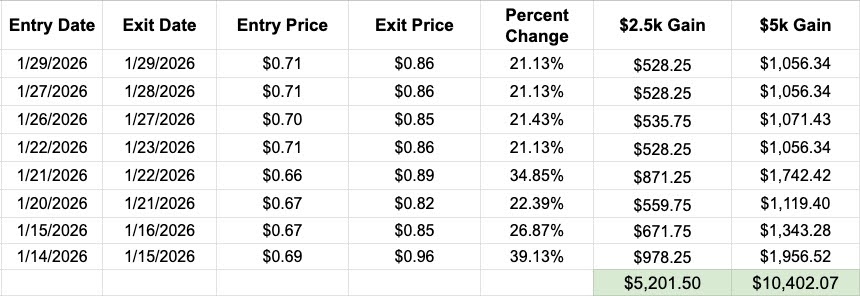
That’s eight consecutive times where they collected payouts worth 25% on average overnight.
Now, I can’t make absolute guarantees on the market here…
But if all goes as planned, we might keep this streak up in February.
We’re already lining new trades up for this week, and if you’d like to see how you can join the next overnight opportunity…
Disclaimer: We develop tools and strategies to the best of our ability but no one can guarantee the future. There is always a risk of loss when trading. Past performance is not indicative of future results. From 10/02/24 to 01/29/26, the average win rate was 80.2% on live published trades. The average return on options trades was 1.95 % over a one-day hold time, with an average winner of 23.88%