
Here’s something that’ll keep you up at night…
Being completely right about market direction — and still losing money on the trade. It sounds impossible, but it happens more often than you’d think, especially with spread trades.
I’ve been thinking about this because it’s one of the most frustrating scenarios in trading. You don’t want to be right about the outcome and still walk away with a loss. That’s the cardinal sin of directional trading, and it usually comes from holding too long or assuming early success guarantees more upside.
The Timing Paradox of Spread Trading
When you’re working with spreads that have extended time frames, there’s a critical decision point that separates successful traders from frustrated ones. Having a level where price reaches your target and automatically triggers an exit isn’t optional — it’s essential.
If price hits that level on schedule, you capture the gain you planned for. But if it hits the level early, the temptation to keep holding can be dangerous. Early success doesn’t mean extended opportunity.
If price tags your target faster than expected, closing the trade protects the profit you earned by being right. The market doesn’t pay extra for perfection — it pays for precision.
Waiting for the spread to reach maximum theoretical value often means giving the market more time to take back what it just gave you. This is why being disciplined about exits matters. Once your thesis has played out, the objective shifts from chasing potential to protecting realized accuracy.
Risk Consistency and Having an Edge
There’s another layer that often gets overlooked. Consistent risk matters just as much as consistent execution.
Jumping between setups, changing trade sizes, or managing one ticker with tight discipline and another with leniency creates unnecessary chaos. Risking the same amount across trades keeps performance measurable and protects your edge.
And that edge is everything. Trading without one isn’t trading — it’s guessing.
The only reason locking in profits early makes sense is because it reinforces the advantage you already created. When your analysis plays out, you capitalize. When you stretch for more, you give randomness a chance to erode that edge.
Being right is hard enough. There’s no reason to make it harder by adding inconsistency, overexposure or greed into the mix.
A precise thesis, a consistent risk approach and a disciplined exit structure create a foundation where being right actually leads to making money.
Now don’t forget to join us at 10 a.m. ET weekdays for Opening Playbook, and at 3:30 p.m. ET Closing Playbook!
Nate Tucci
Tucci Trades
You can also follow along and join the conversation for real-time analysis, trade ideas, market insights and more in my official Telegram channel!
Important Note: No one from the New Money Crew team or Tucci Trades will ever contact you directly on Telegram.
*This is for informational and educational purposes only. There is inherent risk in trading, so trade at your own risk.
How to Target Decent Overnight Payouts This Week
There’s almost nothing better than waking up to fresh deposits in your account.
I know this because traders who followed my No. 1 overnight setup have received eight of those deposits in a row.
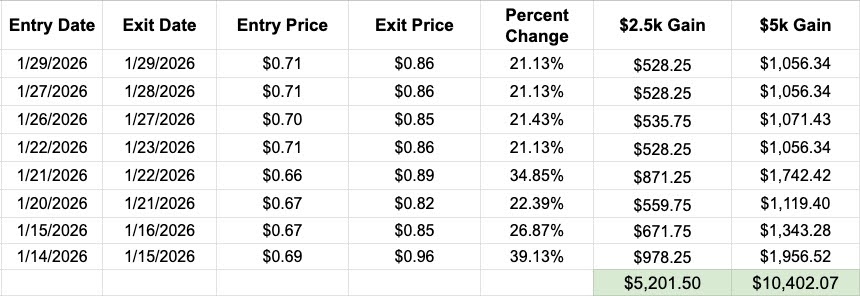
That’s eight consecutive trades where they collected payouts averaging about 25% overnight.
Now, I can’t make absolute guarantees about what the market will do next.
But if conditions cooperate, we may be able to keep this streak going.
We’re already lining up new trades for this week. And if you’d like to see how you can join the next overnight opportunity…
Disclaimer: We develop tools and strategies to the best of our ability but no one can guarantee the future. There is always a risk of loss when trading. Past performance is not indicative of future results. From 10/02/24 to 01/29/26, the average win rate was 80.2% on live published trades. The average return on options trades was 1.95 % over a one-day hold time, with an average winner of 23.88%