
🚨 I’ll be live at 11:30 a.m. ET🚨
We’ll manage and roll our income trades and more [tap to join us for Market Masters]!
Here’s a strategy I run constantly most traders overlook when they’re chasing the next big score…
While everyone’s obsessing over finding the perfect entry on a momentum stock or trying to nail the exact market top, I’ve been quietly building something far more systematic — a simple put-selling strategy that targets 40% annualized ROI.
With a $1.6 million account, a 40% annualized return can generate roughly $640,000 a year, or an average of more than $50,000 per month.
Sound interesting?
Well, that’s the power of math: You don’t need to swing for the fences on every trade. You just need a repeatable process, disciplined risk management and enough time for returns to compound.
Compounding over time is everything in this strategy, and you can start with as little as $1,000 if there are stocks around $10 you’d be comfortable owning.
Before we go further, I work this strategy live at 11:30 a.m. ET each Monday and Friday on my show, Market Masters. Be sure to tune in!
The AI-Powered Screener That Does the Heavy Lifting
I’ve built an AI screener that hunts for a very specific combination of liquidity, volatility, price and probability.
Here’s a recent screener…
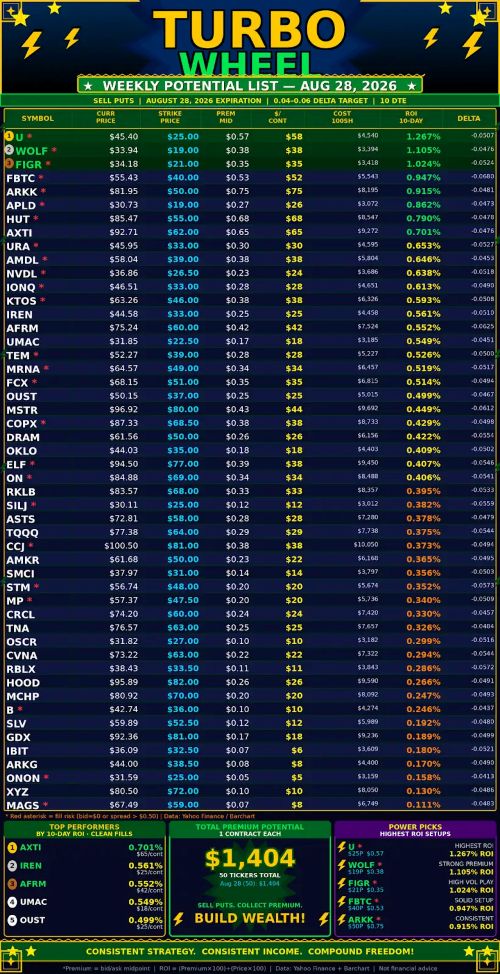
First, I look for stocks averaging at least 10,000 option contracts over several trading days. That signals real liquidity, which can make it easier to enter and exit without getting trapped by wide bid-ask spreads.
Second, I target high-beta stocks at 1.5 or greater. That means their volatility can be significantly higher than the S&P 500 (SPY). Higher volatility generally produces richer option premiums, although that extra income comes with additional risk.
Third, I focus on stocks priced between $30 and $100. For accounts in the $100,000 to $200,000 range, that price band fits the way I want to allocate capital and manage position size. Like I said, anyone can do this same strategy with a much smaller account and let compounding help grow it — we all have to start somewhere.
From there, the screener looks for puts around a 0.04 to 0.06 delta, often with roughly 10 days until expiration. That low-delta range helps identify contracts the market views as having a relatively low probability of finishing in-the-money (ITM), but it does not eliminate assignment or loss risk.
Across one recent list of 50 tickers, selling one contract on each could generate $1,404 in premium. The point isn’t to trade every name blindly. The screen narrows the universe so I can evaluate the best setups rather than chase whatever happens to be moving.
Why Timing Must Fit the Ticker
Anybody who tells you there’s one perfect selling time frame for every ticker is blowing smoke. The ideal expiration can vary dramatically based on the underlying stock and its option term structure.
Take the iShares Silver Trust (SLV). Its richest premium may appear six months out, but I don’t necessarily want to tie up capital that long when shorter expirations let me redeploy it more frequently so I can keep compounding.
Iren Limited (IREN) can look completely different. In one recent setup, its ideal window was about two weeks out. I sold the $36.50 put for a $0.51 credit up front, requiring approximately $1,812 in a margin account and producing a return near 3% over 11 days.
Annualizing that single trade approaches 97%, but that figure assumes repeated reinvestment at similar terms and should not be treated as a guaranteed return.
That’s why this is systematic without being mechanical. The screener finds candidates, then I examine each ticker’s expiration curve, premium and capital requirements before making a decision.
Margin can improve capital efficiency, but it also magnifies risk. Position sizing, available buying power and a plan for assignment remain essential.
And be stubborn on your fills. Don’t automatically accept what the market offers. The market doesn’t hand out free money, and consistently giving up a few cents can add up across dozens of trades.
The beauty of this approach isn’t that it’s exciting. It’s that it gives me a structured way to pursue income while letting discipline and math do the work.
How to Run the Wheel
In a nutshell, the wheel strategy starts by selling a cash-secured put on a stock you’re willing to own at a lower price. You have to have the money in your account to cover assignment, so keep that in mind. Some brokers even give you interest on this cash while it’s locked up!
If the stock stays above the strike you sold, you keep the premium and sell another put (assuming you still like the stock and the premium is still good).
If assigned, the premium lowers your cost basis, and you begin selling covered calls against the 100 shares you now own.
If a call expires worthless, you keep the premium and sell another. If the shares are called away, you collect the sale proceeds and premiums, then restart the cycle with another put.
Here are the golden rules of running the wheel:
✅ DO:
- Only wheel stocks you want to own — Never sell puts on garbage companies
- Have enough cash — Always stay 100% cash-secured ($X × 100 per contract)
- Be patient — The wheel is a marathon, not a sprint
- Keep calls above cost basis — Protect your principal
- Collect premium consistently — Aim for 1-3% per month
- Roll positions when needed — Extend time or adjust strikes
- Track your cost basis — Premium should lower it every trade
❌ DON’T:
- NEVER close at a loss — This is the #1 mistake! Time and premium work for you
- Don’t chase high premiums — Avoid earnings plays and risky stocks
- Don’t over-leverage — Stay within your account size
- Don’t sell calls below cost — You’ll risk locking in losses
- Don’t panic when assigned — Assignment is part of the plan
- Don’t ignore commissions — Factor them into returns
Like I said, we discuss this strategy twice a week on my show, Market Masters at 11:30 a.m. ET on Mondays and Fridays, so be sure to tune in for great plays and more walkthroughs!
Jeffry Turnmire
Jeffry Turnmire Trading
I host my Morning Monster livestream at 9:15 a.m. ET each weekday on YouTube, and then 30 Minutes of Awesome at 5 p.m. ET each Tuesday!
Please check out my channel and hit that Subscribe button!
You can also follow along and join the conversation for real-time analysis, trade ideas, market insights and more!
- Telegram:https://t.me/+6TdDE7-F6GlhMmJh
Important Note: No one from the ProsperityPub team or Jeffry Turnmire Trading will ever message you directly on Telegram.
I’m just a regular dude in Knoxville, Tennessee: a husband, father, civil engineer, urban farmer, maker and trader.
I’ve been at this trading thing with real money for 20-plus years, and started paper trading over 35 years ago. I have a knack for making some epic predictions that just may very well come true. Why share them? Because I like helping other people — it’s the Eagle Scout in me.
*This is for informational and educational purposes only. There is inherent risk in trading, so trade at your own risk.
P.S. 1% a day? This Kind of Consistency Should NOT Be Possible
The daily tactic I’m about to show you is arguably the most consistent setup I’ve ever come across…
Over 172 trades and counting without a single loss, all because I’ve struck upon one of the market’s most consistent daily patterns.
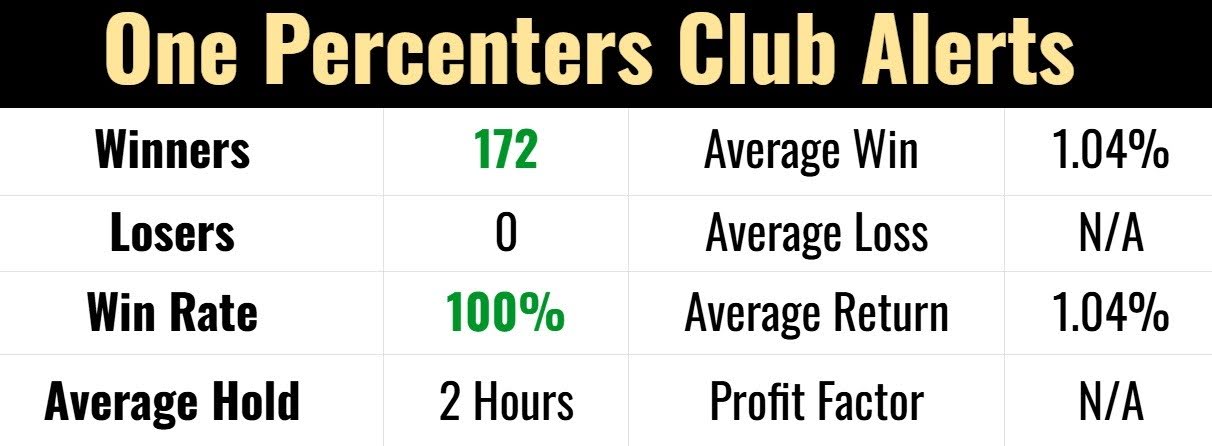
We develop tools and strategies to the best of our ability but no one can guarantee the future.There is always a risk of loss when trading, and past performance is not indicative of future results. From 10/9/25 – 6/29/26, on 172 live trades taken with real money, the win rate is 100%, 1.04% average return, with an average hold time of less than 2 hours.