
🚨 I’ll be live at 10 a.m. ET with Nate Tucci🚨
We’ll discuss understanding risk-reward, the “illusion” of high-risk trading and more [tap to join us for Opening Playbook]!
There’s a question I get asked all the time when I’m setting up fade trades, which I discussed here: What’s the best way to structure the options?
A fade trade is built on a simple idea rooted in reversion to the mean — the tendency for stretched prices to snap back toward a more normal level. When a stock pushes too far in one direction, especially late in the day, that exhaustion often creates an opportunity to position for a controlled, high-probability move the following morning.
Most traders default to buying basic calls. And that’s fine — it’s a solid approach. But over the years I’ve refined my strategy to something that delivers more consistent results: the wrap order.
Before I even get to the trade, I always start by running a scanner. It’s the fastest way to identify stocks that fit my criteria — strong names, clean charts and setups showing signs of exhaustion. Ideally those stocks are also leaders in their sectors because strength at that level often increases the reliability of the move I’m looking to fade.
Let me walk you through three different option strategies for overnight moves, from the most basic to the one I actually use when I want clean, repeatable returns.
The 3 Levels of Option Selection
The simplest approach is just buying stock. No leverage, no decay but also no amplification of your edge.
The next step up is buying basic calls with seven to 10 days till expiration, one strike out of the money (OTM). This gives you clean leverage with minimal time decay, especially since you’re typically only holding overnight.
Here’s where it gets interesting.
My favorite way to trade these setups is the wrap order — an at-the-money debit spread where I buy one strike below the current price and sell one strike above.
The beauty of this structure is simple: If the stock moves just 0.5% to 1% higher, I can pull about 100% return on investment.
Compare that to basic calls. If the stock pops 1%, you might get a decent bump with calls — with the wrap order, I get 100%.
Now I’ll be honest with you — if the stock rips 4%, basic calls will probably be up 300%, far outperforming the wrap. But here’s the thing: Stocks typically aren’t moving 3% in a day. Over time, I find the wrap order delivers more consistent, repeatable wins.
There’s a third option for those who want to avoid all time decay and not worry if the stock’s flat the next day: Go 1% in the money (ITM) on a call. The downside? It’s about six times more expensive than the wrap. You’re paying for certainty.
Before moving on, it’s worth touching on position sizing. I keep it simple — I decide in advance how much I’m willing to put into the trade and size the spread around that number. If I’m normally allocating $200, then I size the spread so the debit lands close to that.
The structure matters but keeping risk fixed matters even more.
This isn’t about getting lucky with a 4% move. It’s about stacking probabilities in your favor with a structure that rewards small, consistent gains. That’s the kind of edge that compounds over time.
So next time you’re setting up an overnight trade, ask yourself: Am I optimizing for the occasional home run or am I building a strategy that wins more often? Because in my experience consistency beats big swings every time.
Graham Lindman
Graham Lindman Trading
Follow along and join the conversation for real-time analysis, trade ideas, market insights and more!
- Telegram:https://t.me/+abM5RWRJKrpkNWI5
- YouTube:https://www.youtube.com/@NewMoneyCrew
Important Note: No one from the ProsperityPub team or Graham Lindman Trading will ever contact you directly on Telegram.
*This is for informational and educational purposes only. There is inherent risk in trading, so trade at your own risk.
P.S. You Want More Than Just the Lotto Board on Saturday?
A while back, I ran a poll in my Telegram channel about the Lotto Board…
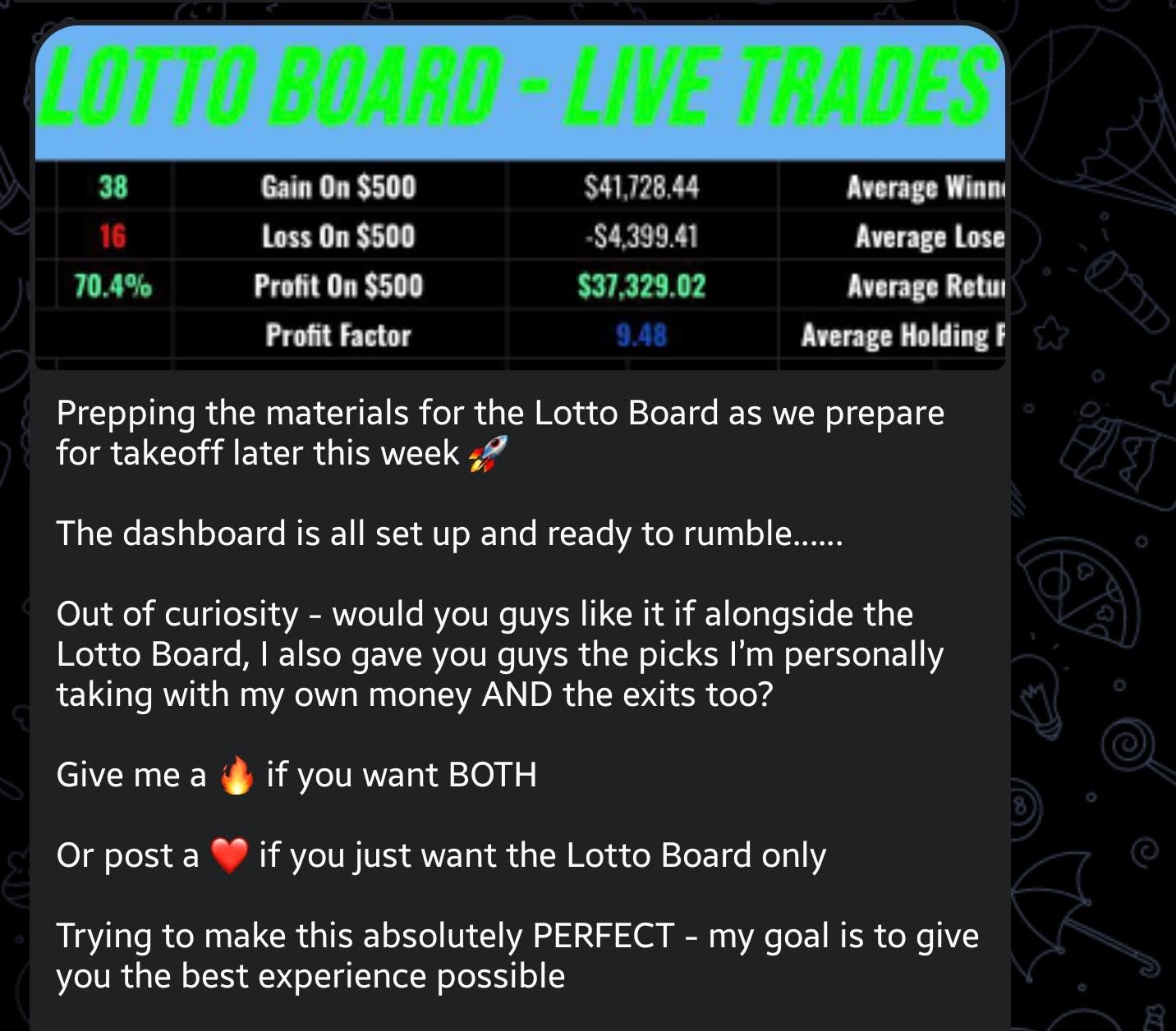
The response was clear: You want more than just access.
Which tells me when I open the doors at 11 a.m. ET on Saturday, you’ll have your hands quite full.
I’ll share the full details very soon, but for now, make sure you don’t miss the Lotto Board Red Carpet Event this Saturday.
Here’s what’s on the agenda.
I’ll give you a complete inside look at how the Lotto Board isolates 2x, 3x and even 4x or more opportunities on a daily basis.
You’ll see the intentional mispricing that creates those setups in the first place… the actual math behind why these opportunities show up…
And then I’ll show you where to get full access to the Lotto Board.
I can’t make absolute trading guarantees…
But at the end of the Red Carpet Event…
You’ll have the opportunity to start using the Board for your own trades as early as next Monday.
All you have to do is register to save your seat…
We develop tools and strategies to the best of our ability but no one can guarantee the future. There is always a risk of loss when trading. Past Performance is not indicative of future results. Between 1/8/26 through 2/17/26 the “Lotto Board” trades taken with real money by Graham Lindman have produced a 79.5% win rate, with an average return of 170% and an average winner of 230% over a 9 day hold time on average – and a 19.93 Profit Factor