🚨 I’ll be live at with Alex at 2:30 p.m. ET🚨
We’re diving straight into how you can grab pre-IPO shares of SpaceX through your regular broker before the long weekend. We’ll also show you why the 10-year selloff just neutralized the bond scare and reveal the top institutional flows hitting our scanners today [tap to join us for Profit Panel]
I’ve been using a simple moving average setup on Nasdaq-100 (QQQ) for a while now — the kind of system that just works when you stick to the rules.
It runs on the 15-minute chart using the five and 10 simple moving averages, and over time it’s become a reliable part of my playbook.
But the other day I got curious.
Oil has been bouncing all over the place lately, so I figured: Why not throw that same strategy on United States Oil Fund (USO) and see what happens?
Turns out, it worked.
The Setup That Traveled
The structure of the strategy is straightforward: You watch how price behaves around those two moving averages on the 15-minute chart.
When price stalls or rolls over relative to those lines, that’s the trigger.
Around 10 o’clock, USO kept failing to get back above the 10 SMA. It tried, slipped, tried again, then rolled — and I hit it. It dropped cleanly.
Now, I’ll admit it right up front — it still works better on QQQ. When I dug back through the charts, USO held up fine, but QQQ remains the cleaner instrument for these signals.
Even so, the reason I tried it at all was simple. Oil has been moving every single day — up, down, sideways — so I figured it was the perfect testing ground. And it really did behave.
When the Market Fights Itself
That same morning, the broader market was having one of those tug-of-war sessions.
The S&P 500 (SPY), the iShares Russell 2000 ETF (IWM) and the Dow Jones Industrial Average (DIA) were all pushing down, while QQQ — boosted by Apple (AAPL) — kept refusing to join them.
It would get dragged lower, shake it off and finally just snap upward and pull everything else with it.
That kind of internal conflict makes intraday setups trickier, and it’s a good reminder to pay attention to which index is actually leading the charge.
Could this moving average setup work on other tickers? Possibly. There are plenty of opportunities outside QQQ to test ideas, and SPY is a natural candidate.
But I wouldn’t touch DIA with this method — that thing has a personality all its own, and not one I trust for this type of short-term structure.
If you’re experimenting with applying a familiar system to a new instrument, backtest it first — and then keep gathering data.
One good trade doesn’t prove anything. You want repetition, consistency and enough real-time reps to know whether the edge holds up.
The more data points you build, the better you understand how the setup behaves across different products.
The real takeaway is this: There are always new edges to learn, and the more tools you develop, the more adaptable you become.
Staying open, testing ideas and expanding your playbook is what keeps you sharp in a market that changes every day.
👉 Click here to join Profit Panel at 2:30 p.m. ET on weekdays!
Profit Panel equips traders to adapt to any market condition, by knowing when to trade aggressively and when to stand aside, live at 2:30 p.m. ET Monday-Friday.
Geof Smith
Geof Smith Trading
Follow along and join the conversation for real-time analysis, trade ideas, market insights and more!
- Telegram: https://t.me/+lm8_Nq3Su104NmFh
- YouTube: https://www.youtube.com/@FinancialWars
Important Note: No one from the ProsperityPub team or Geof Smith Trading will ever contact you directly on Telegram.
*This is for informational and educational purposes only. There is inherent risk in trading, so trade at your own risk.
P.S. There Is a Massive Shift Coming…
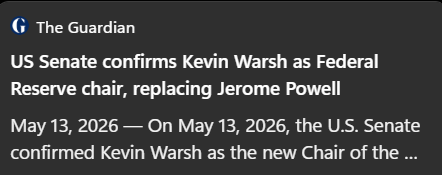
A massive shift is on the cards as Warsh takes over as fed chair… are you prepared?
I recently went live to reveal the no. 1 play traders need to know to capitalize on this massive market shift.
Disclaimer: We develop tools and strategies to the best of our ability, but we can’t guarantee the future. There is always a risk of loss when trading. Past performance is not indicative of future results. Since LIVE trading began on 9/18/25, there have been 24 trades, with 20 winners and 4 still open, continuing the undefeated streak. In LIVE trading, the average return has been 32.03%, and the average hold time has been 17 days.