
🚨I’ll be live at 10 a.m. ET with Nate🚨
We’ll cover some intriguing data for SPY and QQQ, 1970s inflation vs. today, massive earnings on deck and more [tap to join us for Opening Playbook]!
Here’s something that can make or break your options strategy…
Knowing when to use calls versus puts based on your position relative to the current price. It’s not just about risk-reward ratios — it’s about protecting yourself from early assignment that can turn a winning trade into a guaranteed loss.
This distinction trips up even experienced traders. In fact, when I recently polled a group on whether they’d choose calls or puts for a similar setup, the responses came in nearly 50-50, which shows how easy it is to overlook the mechanics behind this choice.
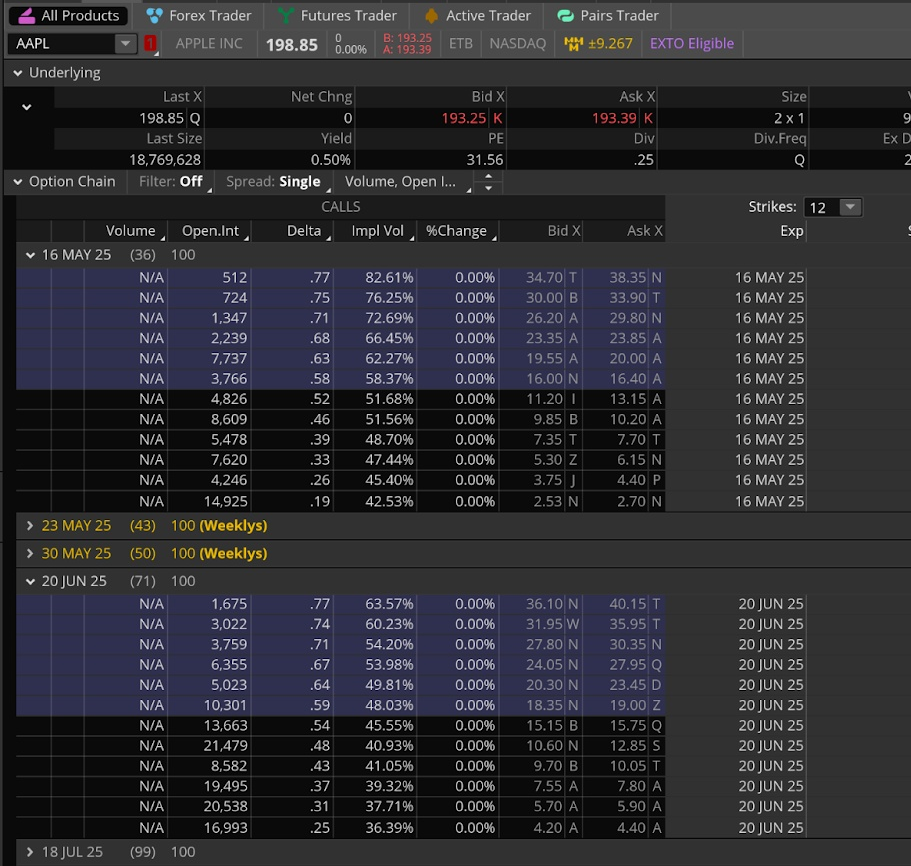
I want to walk you through my wrap order methodology, which centers on one key principle: minimizing the possibility of getting exercised early. When I use the term “wrap order,” I’m referring to an at-the-money debit spread, usually employing calls on either side of the current price, effectively wrapping around it.
The decision between calls and puts isn’t arbitrary — it’s based on whether you’re trading in-the-money (ITM), at-the-money (ATM) or out-of-the-money (OTM).
Conservative ITM Trades: The Bull Put Credit Spread Advantage
When I’m trading conservatively with deep ITM positions, I use a bull put credit spread. The reason is simple: When we’re deep ITM, our risk of assignment is minimal and the structure allows us to collect premium efficiently.
There’s also a practical financial advantage that often goes overlooked. A bull put credit spread not only protects against unnecessary assignment, it also eliminates closing costs. This approach lets you pocket the full premium without worrying about extra assignment or close-out fees, typically adding about 1% to your annualized yield.
That’s the beauty of the income-style approach — minimal intervention, minimized fees and a structure designed to let trades expire for full value. Those incremental savings and boosted yields compound over the long term more than most traders realize.
ATM and OTM: Why Calls Protect Your Capital
Things shift when we move ATM or OTM. In those scenarios we’re going to use a debit spread with calls. This isn’t just a preference — it’s practical risk management. While textbook formulas show the same risk-reward for calls and puts, real-world trade management exposes you to more risk with puts — calls are structurally safer for wraps.
Here’s why that matters…
If I were to use puts on an ATM trade and the underlying dips, the put I sold may be exercised against me, which is going to guarantee a full loss. Even worse, this can happen while there’s still plenty of time left for the trade to recover.
That early assignment risk isn’t theoretical. On certain platforms, such as Robinhood, early assignment is more common, which makes this choice even more critical.
Let’s look at a recent example using SPDR Gold Shares (GLD). The setup required GLD to gain only about $1 — roughly a 0.25% move — to achieve around a 100% return on investment.
That type of precision is possible only when your strike selection and option type match the market environment. A wrap order with calls allowed the trade to capture that upside efficiently without exposing the position to premature assignment.
Pro Tip: When entering these positions, start your limit order as close to 50 cents as possible for a balanced 1:1 risk-reward ratio. If you don’t get filled immediately, slowly increase the order a few cents at a time. I generally want to see fills above 55 cents to ensure the structure is paying what it should while still keeping execution risk low.
Managing time is just as important as managing price. For GLD trades specifically, I typically hold positions at least until the week of expiration. Avoid exiting before Wednesday unless the market gives a compelling reason.
Holding into expiration week lets time decay do its job without exposing the trade to unnecessary early assignment, which aligns perfectly with the wrap order’s design.
The key takeaway? When you wrap — which is just an ATM debit spread — use calls. It keeps the structure intact, your risk defined and your trade protected from outside forces that could otherwise lock in a guaranteed loss.
For a step-by-step walkthrough and live case studies, access our wrap order video in the Opening Playbook archive.
Graham Lindman
Graham Lindman Trading
Follow along and join the conversation for real-time analysis, trade ideas, market insights and more!
- Telegram:https://t.me/+abM5RWRJKrpkNWI5
- YouTube:https://www.youtube.com/@NewMoneyCrew
Important Note: No one from the ProsperityPub team or Graham Lindman Trading will ever contact you directly on Telegram.
*This is for informational and educational purposes only. There is inherent risk in trading, so trade at your own risk.
P.S. The Options Market Is Far From Efficient!
There’s a weird glitch that regularly misprices contracts in the options chain. Pricing them way below true value.
The good thing is, I’ve been exploiting it for a shot at weekly payouts.
Want to see exactly how you can do the same?