🚨 I’ll be live at 10 a.m. ET with Graham Lindman🚨
We’ll take a look at gold vs. SPX, a ton of big-time earnings reports this week, gearing up for the melt-up, a market overview and more [tap to join us for Opening Playbook]
There’s something most traders get wrong about momentum.
You see the market rip higher intraday — maybe up 1% or more — and the immediate thought is: We’re overextended. Time to fade this.
I get it. It feels logical. The market pushed too far, too fast, and it should be due for a pullback.
But here’s the thing: The data says the exact opposite.
When you look at sessions that match the same broad market conditions we’re trading in now, the picture becomes clearer. Across hundreds of similar days over the past couple decades, the majority of sessions moved higher from the 9:45 a.m. price into the close.
That consistent behavior is what gives this pattern real weight, and it shows why reacting emotionally to strength often puts traders on the wrong side of the tape.
The Down-Day Pattern That Changes Everything
Now here’s where the nuance matters: Even on the days that ultimately close lower, the intraday behavior is telling.
Those down days typically see only modest highs — not major surges — before rolling back over. The intraday high on up days tends to expand more clearly, while the intraday peak on down days stays relatively contained.
That detail matters because it tells us something important about momentum. If the market is going to fail, it usually won’t make a big push first.
So when you see the market open higher and then extend another half percent or more, that’s not a sign of danger. That’s a sign it’s behaving like the higher-probability sessions — the ones that tend to continue.
This also ties into the broader environment. A mixed sector backdrop, where leadership rotates and multiple groups contribute to the move, tends to stabilize momentum instead of undermining it.
When strength isn’t concentrated in just one corner of the market, it becomes harder for any single weak sector to drag everything lower, which can delay or soften any expected pullback.
Turning Data Into Action
Once you understand the probabilities behind these intraday moves, the setup becomes far more actionable.
If the market pushes beyond roughly a quarter to half a percent of additional intraday momentum, it often signals a point where a close back below the opening levels becomes less likely.
This is where traders can shift from reactive to strategic.
For example, once the day’s gain crosses around 1%, history shows that the odds strongly favor a finish above the open. That’s information you can actually use in your risk management.
Instead of fearing strength, you can structure trades with a probability-based mindset. That might mean tightening downside expectations below the open, adjusting stops or leaning into the prevailing direction rather than assuming it’s overdone.
Momentum isn’t random. It’s a recurring pattern with measurable tendencies, and when you align with those tendencies instead of fighting them, your trading becomes quieter, calmer and more consistent.
Now don’t forget to join us at 10 a.m. ET weekdays for Opening Playbook, and at 3:30 p.m. ET Closing Playbook!
Nate Tucci
Tucci Trades
Follow along and join the conversation for real-time analysis, trade ideas, market insights and more!
- Telegram: https://t.me/nate_tucci
- YouTube: https://www.youtube.com/@NewMoneyCrew
Important Note: No one from the New Money Crew team or Tucci Trades will ever contact you directly on Telegram.
*This is for informational and educational purposes only. There is inherent risk in trading, so trade at your own risk.
P.S. We’re Going After My 100th Trade — Killing a Bird With 2 Stones
I’ve been deploying a unique approach to the market for at least 15 months. One that allows me target cash whichever direction the market or the stock decides to go.
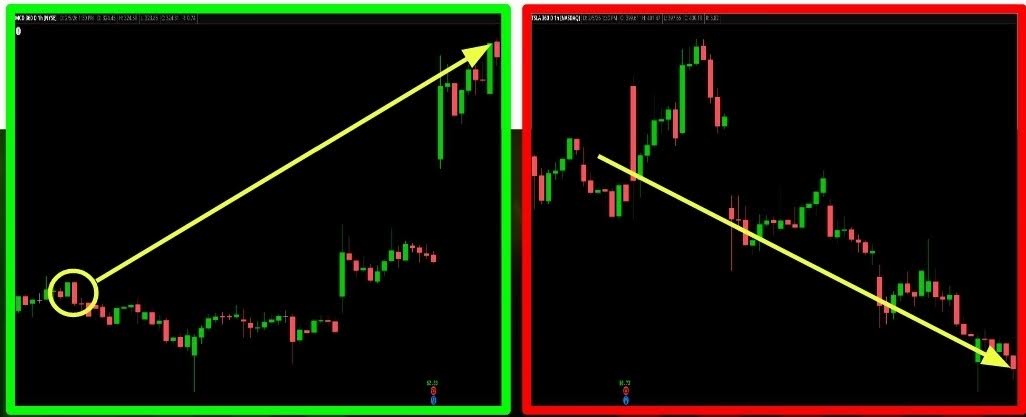
The next opportunity opening up right now is our 100th trade and I would like you to join in on the milestone with me.
Disclaimer: We develop tools and strategies to the best of our ability, but no one can guarantee the future. There is always a risk of loss when trading past performance is not indicative of future results. Since 1/12/24, the strategy has issued 99 closed trades, for a total win rate of 72.8%. The average gain, winners and losers included, has been 5.12% per trade over an average holding period of 20 days.