🚨 Alex will be live at 2:30 p.m. ET🚨
With me being out today and traveling, Alex is holding down the fort solo to cover whether we should be aggressively adding on this dip as the major indices pull back, the specific stocks on the radar right now, and a deep dive into the latest market flows to hunt for the highest-probability, data-driven snapback opportunities [tap to join us for Profit Panel]
I came across a statistic recently that immediately grabbed my attention. At first glance, it looks like the kind of number that should send prices soaring.
Only about 14% of the winter wheat crop across several major U.S. growing states is considered good. The rest ranges from fair to poor, creating one of the weakest crop conditions growers have seen in years.
States like Colorado, Oklahoma, Texas, Kansas and Nebraska sit at the heart of U.S. winter wheat production. When conditions deteriorate across that region, it gets people’s attention.
The immediate assumption is simple: Smaller crop equals higher prices.
But markets are rarely that straightforward.
Why the Global Market Doesn’t Care
The reality is this: The U.S. is only one piece of the global wheat market.
Many traders look at domestic crop conditions and assume the world will react the same way. That works for some commodities, but wheat is different.
Wheat is produced across multiple regions around the globe. When one major producer struggles, other suppliers often step in to help fill the gap. That ability to substitute supply helps keep global prices relatively stable.
This is very different from commodities where production is more concentrated. In those markets, a poor crop can create a much larger supply shock.
With wheat, buyers have options. They can source grain from different countries, reducing the impact of problems in any single region.
That does not mean the crop failure is unimportant. It simply means the global market views it differently than many traders expect.
What It Means for Prices
This is where things get interesting.
Even if global wheat prices remain relatively calm, domestic prices can still move higher. U.S. wheat contracts are tied to U.S. supply conditions, and tighter local inventories can create upward pressure.
That means wheat prices could continue to find support in the near term, especially if crop conditions fail to improve.
But expectations need to remain realistic.
Because wheat is traded globally, large price spikes tend to attract additional supply. Buyers adjust, exporters respond and the market works to balance itself.
In other words, local conditions can matter without creating a worldwide shortage.
The Bigger Lesson
The lesson here extends far beyond wheat.
One of the biggest mistakes traders make is assuming bad news automatically leads to higher prices.
Markets care about context.
A disappointing crop matters. A disappointing crop within a global market that has alternative sources of supply matters a lot less.
That is why understanding the broader supply picture is often more important than reacting to a headline.
I am watching the wheat market closely, but I am not expecting this crop disaster to create the kind of explosive move many traders are anticipating.
Sometimes the story looks dramatic.
The market response is often much less exciting.
Geof Smith
Geof Smith Trading
Follow along and join the conversation for real-time analysis, trade ideas, market insights and more!
- Telegram: https://t.me/+lm8_Nq3Su104NmFh
- YouTube: https://www.youtube.com/@FinancialWars
Important Note: No one from the ProsperityPub team or Geof Smith Trading will ever contact you directly on Telegram.
*This is for informational and educational purposes only. There is inherent risk in trading, so trade at your own risk.
P.S. What the Media Outlets Are Completely Ignoring Right Now
By now, you might be aware that the Senate recently confirmed the new Fed Chair.
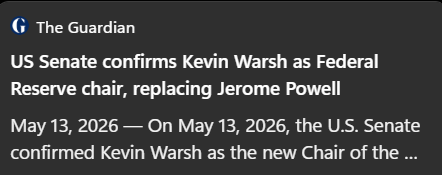
And based on my research… Warsh might set in a huge shift that I’m not seeing the media outlets talk about enough.
A shift that could prove rewarding for traders in the know.
I’ve spent three decades trading the markets…
And over the years, the Fed has singlehandedly triggered this shift, and it’s been rewarding for folks in the know.
I recently went on camera to spill the beans about this massive shift that Warsh could bring as Fed Chair.
And I also reveal the no.1 play every trader needs to know to take advantage of.
I won’t make reckless guarantees…
But if you want the details on this approach…
Tap Here to Get the Entire Breakdown
Disclaimer: We develop tools and strategies to the best of our ability, but we can’t guarantee the future. There is always a risk of loss when trading. Past performance is not indicative of future results. Since LIVE trading began on 9/18/25, there have been 24 trades, with 20 winners and 4 still open, continuing the undefeated streak. In LIVE trading, the average return has been 32.03%, and the average hold time has been 17 days.