
JOIN ME LIVE AT 9 AM ET FOR: TRENDING THURSDAYS
There’s a piece of historical context I’ve been thinking about that completely reframes how I’m viewing the current market environment.
While everyone’s debating whether we’re in a bubble and when the inevitable crash is coming, I pulled up the actual data on bull and bear market cycles, and what I found suggests we’re probably nowhere near the end of this run.
Bull markets historically last about four to five years, while bear markets typically run about one year. That’s not opinion — that’s the historical norm that’s played out over decades.
Our last bear market ran from January through November 2022. If we mark November 2022 as the bottom, then year one ends in November 2023, year two covers 2024, and year three is 2025.
That means we’re only in year three of an average four-to-five-year bull market. So it’s very possible this bull market still has plenty of room to run.
This market has also done a pretty amazing job climbing this wall of worry for the last several years. Everyone’s been calling for recession, everyone’s been hedging aggressively, and the put-call ratios have been heavily tilted toward the put side. Yet here we are, making new highs. The resilience we’re seeing fits right into the broader historical pattern.
Positive days, positive weeks, positive months — these are stats I find really interesting. This is our edge. History, for me, is the edge.
The Bubble Talk Is Probably Premature
I keep hearing all this bubble talk in 2025, and honestly, I don’t think people understand what a real bubble actually looks like. If we’re genuinely going to see an everything bubble, we’re probably talking about the S&P 500 at 7,500 or 8,000 first.
It could even stretch to 10,000.
The market has been climbing despite constant skepticism, which tells me we’re not in the euphoric phase that typically signals a true bubble top.
I don’t think we’re going to see a full market dump in the next 30 or 45 days — that feels improbable given the current setup. But if there are weakness windows to watch, they could show up in April or May when Jerome Powell steps down and a new Fed Chair steps in.
That transition might create some uncertainty.
What I’m Watching for 2026 and Beyond
Looking ahead, here’s my probabilistic framework: If we’re lucky, 2026 is another up year. If we’re challenged a bit, it’s a sideways year. And if the sky is falling, we know how to stay out.
Another potential soft spot is Q1 earnings season in February or March, especially if results disappoint. But the bigger picture is that historical cycles suggest this bull market has room to run. We’re not at year four or five yet. We’re in year three.
If history is any guide, that means staying constructively positioned while remaining tactically aware of potential volatility windows.
I’ll see you in the markets.
Chris Pulver
Chris Pulver Trading
Follow along and join the conversation for real-time analysis, trade ideas, market insights and more!
- Telegram:https://t.me/+av20QmeKC5VjOTc5
- YouTube:https://www.youtube.com/@FinancialWars
- Twitter:https://x.com/realchrispulver
- Facebook: https://facebook.com/therealchrispulver
Important Note: No one from the ProsperityPub team or Chris Pulver Trading will ever contact you directly on Telegram.
*This is for informational and educational purposes only. There is inherent risk in trading, so trade at your own risk.
P.S. Don’t Take This Market Range for Granted
It’s not hard to see why…
All you have to do is leverage a special range in the market to target payouts in just hours…
With just $1,000 per trade!
This straightforward approach has delivered an 89.2% win rate on over 400 live trades.
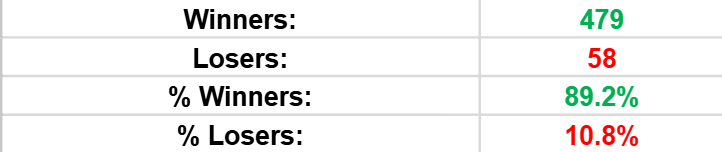
Want to see how to set up this trade?
We develop tools and strategies to the best of our ability, but no one can guarantee the future. There is always a risk of loss when trading. Past performance is not indicative of future results. Stated results are from live published alerts between 8/26/24 and 12/11/25. The win rate has been 89.2% on the options with an average return of 14.46% over a one-day hold time.