🚨 I’ll be live at 9 a.m. ET🚨
Upside risk is real but pullbacks are likely to burn off overbought conditions while geopolitical catalysts hang over everything — we’ll discuss how to stay the course and more [tap to join us for the Daily Profit Plan]!
Something interesting played out last week that perfectly illustrates a principle I talk about all the time — momentum matters more than fundamentals. When stocks are already trending higher, that trend itself becomes a structural force.
If a stock is in an uptrend, the probability of it breaking below a recent low over the next 45 days is unusually small, which is why momentum so often outweighs whatever the earnings report says.
Four of the Magnificent Seven — Amazon (AMZN), Google (GOOGL), Meta (META) and Microsoft (MSFT) — all reported earnings. Every one of them beat both top and bottom line estimates.
Yet only two were rewarded with higher prices while the other two sold off. The market wasn’t reacting to the numbers as much as it was reacting to where these stocks were already positioned.
That message gets even clearer when you consider that the market doesn’t care about anything outside these core price and positioning dynamics right now. Macro headlines, geopolitical risk and political drama are all treated as noise because the market is being driven by a narrow set of internal forces — tech leadership, margin expansion and earnings momentum.
Uptrends Got Rewarded, Consolidation Got Punished
Amazon and Google were sitting at all‑time highs and in powerful uptrends heading into earnings. Positive gamma flows were already pushing price action higher, and the expected move was tilted to the upside. When the market wants to keep going higher, you don’t fight it — the structure was already in place to reward good news.
Sure enough, AMZN and GOOGL gapped up to fresh highs.
META and MSFT were telling a different story. Both had been consolidating instead of trending, and that softer structure created vulnerability. Even though their fundamentals beat expectations just like the other two, the lack of upward momentum meant the market punished them.
META dropped about 7% to roughly $612 and MSFT slipped to $418. It’s a sharp reminder that price action guides reactions far more than raw financials, especially during earnings season.
It’s also worth noting that while these trends are powerful, the rally beneath the surface is not as healthy as the headline numbers suggest. Market breadth has been slipping, with the percentage of S&P 500 stocks trading above their 50‑day moving average falling from more than 60% to under 50%. Uptrends can continue in thin conditions, but they tend to get more fragile as participation narrows.
How I Played These Earnings Trades
I structured broken wing butterfly trades on all these names going into the reports. The GOOGL trade — a 330‑327.50‑317.50 structure for 55 cents — hit full profit. I closed it for a 1‑cent debit, booking a 98.2% return.
AMZN’s 240‑237.50‑230 broken wing butterfly for 46 cents was also tracking perfectly because the strong upward move made a drop back toward the pin price highly unlikely.
META was more frustrating. It filled at 50 cents on the 605‑600‑590 broken wing butterfly after the post‑earnings drop brought the strikes into range, but that fill should have been 65 to 70 cents based on where the market was trading.
That’s a real example of how broker fills can affect outcomes even when the strategy and analysis are spot on. MSFT never filled because its modest $6 dip wasn’t enough to push price toward the needed pin level near $385.
These trades weren’t random. They were built from a deliberate strategy designed to harness momentum and asymmetric risk. If you want big reward potential, there’s no better structure than these double‑up style broken wing butterflies.
They take advantage of expected move dynamics, upside bias and the way price tends to behave after news. And when price stays sideways or up — or even down slightly — the structure can capture the entire expected move to the downside while risking almost nothing.
The takeaway is simple. Momentum dictates reactions, not fundamentals.
Uptrends strengthen the probability of continuation, and options market structure reinforces that behavior. When you build trades that align with those forces, you position yourself to win consistently. That’s exactly what we did across every news‑driven setup this week, using the same repeatable process to capture move after move.
I’ll see you in the markets.
Chris Pulver
Chris Pulver Trading
Follow along and join the conversation for real-time analysis, trade ideas, market insights and more!
- Telegram:https://t.me/+av20QmeKC5VjOTc5
- YouTube:https://www.youtube.com/@FinancialWars
- Twitter:https://x.com/realchrispulver
- Facebook: https://facebook.com/therealchrispulver
Important Note: No one from the ProsperityPub team or Chris Pulver Trading will ever contact you directly on Telegram.
*This is for informational and educational purposes only. There is inherent risk in trading, so trade at your own risk.
P.S. There’s Something Pretty Shocking The Media Will NEVER Talk About…
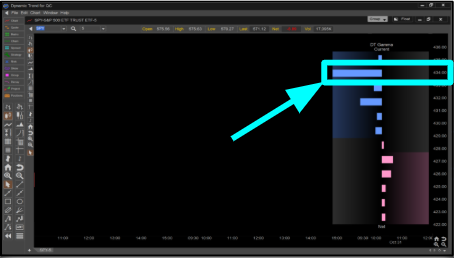
Thanks to liquidity levels, you can now track Wall Street’s undercover orders in real time…
And target daily returns every day the market’s open!