
🚨 I’ll be live at 9 a.m. ET🚨
A one-day cool-off isn’t a bad thing after 72% of S&P 500 stocks finally fell Friday, chips and large-cap tech down big, bull market support at key support levels and more [tap to join us for the Daily Profit Plan]!
I want to share something I’ve been tracking for a while now — a consistent market behavior that’s been shaping the way I structure my daily trades, especially when we’re pushing into new highs.
Here’s the pattern: Markets rarely close the day at their absolute high. Instead, they tend to give back nine, 10, 15 or 20 points before the close. It’s not a hard rule and we’ve definitely seen exceptions.
Back in April, during that crazy bull rip, we had several days where the market literally closed at the high every single day. But those situations are anomalies, not the norm.
When we do push into those extremes, I’m focused on probabilities, not certainties. I’m always asking whether we actually stay pinned by the end of the day or fall back a little, because that small reversion shows up far more often than the perfect pin.
Understanding this tendency has become a core part of how I position trades — particularly when I’m selling premium near expected move highs.
How I Use This to Structure Daily Trades
When the S&P 500 (SPX) was pushing toward 7,500, I structured an aggressive Daily Profit Play iron condor with the short call right at 7,500 — my calculated expected move high for the day.
There was a lot of gamma built up in that zone, which often creates natural hesitation or pinning behavior around key levels. I collected $4 in credit while risking only $100, a setup that puts defined math behind the edge I’m looking for.
Even if price tags my strike or slightly exceeds it, the probability of a late-day fade works in my favor. I’m comfortable selling calls right at or slightly above expected move highs because I’m anticipating that mean reversion. And if that move comes early, I’m happy to take 80% of max profit and close the trade.
It’s simply more capital efficient than squeezing out an extra few bucks when the bulk of the premium has already decayed.
The ideal scenario isn’t necessarily that the market avoids my strike — it’s that the market touches or slightly exceeds it, then drifts back into range before the close. That’s where this pattern shines.
I’m not chasing momentum or hoping for a runaway move. I’m positioning for the behavior that shows up more often than not — the pullback before the closing bell.
Probability Over Perfection
Look, the market can absolutely pin at the highs. But I’m trading what happens most of the time, not the exceptions. That approach has served me well. Over the past stretch we’ve been winning 94% of our stack trades with individual trades landing around 80% winners. That’s not luck — it’s the result of repeating the same disciplined process day after day.
Everything I do starts with risk management. It’s dollars and percentages, making sure every position is something I can routinely execute without emotion or guesswork. That consistency is what keeps me grounded and what ultimately pays the bills.
I’ll see you in the markets.
Chris Pulver
Chris Pulver Trading
Follow along and join the conversation for real-time analysis, trade ideas, market insights and more!
- Telegram:https://t.me/+av20QmeKC5VjOTc5
- YouTube:https://www.youtube.com/@FinancialWars
- Twitter:https://x.com/realchrispulver
- Facebook: https://facebook.com/therealchrispulver
Important Note: No one from the ProsperityPub team or Chris Pulver Trading will ever contact you directly on Telegram.
*This is for informational and educational purposes only. There is inherent risk in trading, so trade at your own risk.
P.S. Today’s Roundtable Is Starting Soon
Sorry this is coming pretty last-minute…
But we’re at a major turning point right now.
Friday was Jerome Powell’s last day as Chair of the Fed, with Kevin Warsh now set to take over.
Many view him as being closely aligned with Trump. So the big question now is… what happens next?
Will interest rates stay high? Will the Fed begin cutting rates? Or could rates actually rise even further?
And more importantly…
How could Warsh affect the stock market, options trading and volatility moving forward?
Join in at 10 a.m. ET today for a live roundtable discussion as Lance, Graham, Nate and I break it all down…
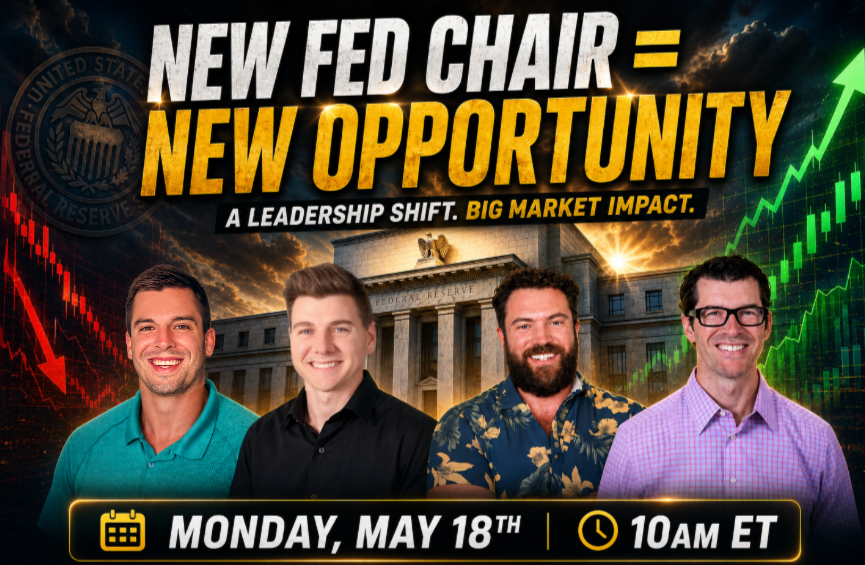
And share some actual trade ideas based on what we believe could happen next under the Fed’s new leadership…
I won’t make reckless guarantees when it comes to the stock market…