🚨I’ll be live at 10 a.m. ET with Graham🚨
Happy Friday! I think I just stumbled onto a new trade for this market and want to show you how it works [tap to join us for Opening Playbook]
Markets are hitting fresh all-time highs, but here’s the part most investors aren’t noticing — more stocks are dropping than rising on those days.
When more than half the market is declining while the major indices keep climbing, you’re not looking at broad strength. You’re looking at concentrated leadership and a market that’s quietly forcing you into stock-picking if you want to keep up.
That kind of backdrop naturally pushes equal-weighted approaches and catch-up setups right to the front of the conversation.
Not every sector is lagging anymore, which actually makes the divergence even more interesting. Energy (XLE) and Industrial (XLI) are now leading the S&P 500 (SPY) year to date alongside tech, while much of the rest of the market still trails badly behind.
And the reason is still largely the same: Technology (XLK) continues to dominate the tape.
Since the April 2nd low, XLK has rallied roughly 29% in about 30 trading sessions. That’s an extraordinary move for a sector that already carries massive weight inside the index.
Meanwhile, Utilities (XLU) still can’t get out of its own way. Even with the entire AI power-demand narrative gaining traction, utilities remain stuck under the pressure of rising-rate concerns and bond-market competition.
So the real question is whether the Invesco S&P 500 Equal Weight (RSP) is a laggard doomed to keep falling behind or whether it’s actually a catch-up trade waiting for the right spark.
There are signs a spark may already be forming. Areas like Health Care (XLV), Basic Materials (XLB), and pockets of cyclicals are starting to stabilize and quietly improve underneath the surface.
The catch, of course, is scale. Even with XLE and XLI helping broaden participation, tech still carries such overwhelming weight that the rest of the market can’t close the gap overnight unless we get a much larger rotation event.
Still, opportunity doesn’t always come from matching the leaders — sometimes it comes from everything else finally getting off the mat.
The Momentum vs. Mean Reversion Dilemma
There are really only two ways this market broadens.
Either the laggards start catching up in a meaningful way, or the leaders keep grinding higher until eventually the rest of the market gets pulled along through simple mean reversion.
RSP and equal-weight indices like the NASDAQ 100 Equal Weighted Index (QQQE) are some of the clearest tools to watch for that shift.
The backdrop is complicated. The mega-caps have run incredibly far, yet some of them actually have lower forward P/E ratios now than they did before April 2nd.
That’s the remarkable part.
After one of the strongest Q1 earnings seasons we’ve seen in years, earnings growth has actually outpaced price growth in many of these names. So while sentiment screams bubble, the valuation picture is far more nuanced than most people realize.
That doesn’t mean tech can’t cool off — just that this rally isn’t purely multiple expansion.
NASDAQ 100 (QQQ) is now sitting roughly 14% above its January prior highs, trading around $721. That’s a massive extension, and it naturally keeps momentum traders leaning bullish.
But the more stretched the leaders become, the more likely it is that money eventually starts rotating toward the rest of the market.
And if you want to express that view with precision, there are more ways than simply buying RSP.
Some traders lean on deep in-the-money calls and sell premium against them to collect steady income.
Others use unbalanced butterflies or condors, giving themselves uncapped upside while still getting paid if price simply behaves and stays inside a range.
These aren’t moonshot trades — they’re structured ways to benefit if equal weight simply does what it’s been trying to do for months: Quietly grind higher.
There’s also a more aggressive angle.
If breadth really starts to expand, the biggest percentage movers may not be large caps at all.
Small-cap AI names, smaller semiconductor stocks, and anticipated IPO catalysts could become the sharpest catch-up candidates once capital finally looks beyond the usual giants.
Where Does That Leave Us?
None of this means RSP is suddenly going to outperform QQQ or that tech is ready to roll over tomorrow.
It simply means the setup for mean reversion is getting stronger as this rally becomes increasingly concentrated.
When you have a market hitting all-time highs while breadth stays weak, when QQQ is trading 14% above prior highs, and when XLK continues doing most of the heavy lifting, you’re looking at conditions that historically don’t stay this narrow forever.
The leaders have run hard. Much of the market still hasn’t participated.
And tucked between those extremes is the kind of environment where equal-weight strategies can quietly start making up ground.
Something to keep in mind as this stretch of concentrated leadership eventually gives way to whatever comes next.
Now don’t forget to join us at 10 a.m. ET weekdays for Opening Playbook, and at 3:30 p.m. ET Closing Playbook!
Opening Playbook is a bridge for both new and advanced traders to go beyond outdated market narratives into deeper understanding, live at 10 a.m. ET Monday-Friday.
Nate Tucci
Tucci Trades
Follow along and join the conversation for real-time analysis, trade ideas, market insights and more!
- Telegram: https://t.me/nate_tucci
- YouTube: https://www.youtube.com/@NewMoneyCrew
Important Note: No one from the New Money Crew team or Tucci Trades will ever contact you directly on Telegram.
*This is for informational and educational purposes only. There is inherent risk in trading, so trade at your own risk.
P.S. I Have an Overnight Breakthrough to Show You
There’s almost nothing better than waking up to fresh deposits in your account.
I know this because traders who were in on my no. 1 overnight setup have received the opportunity to see seven consecutive deposits.
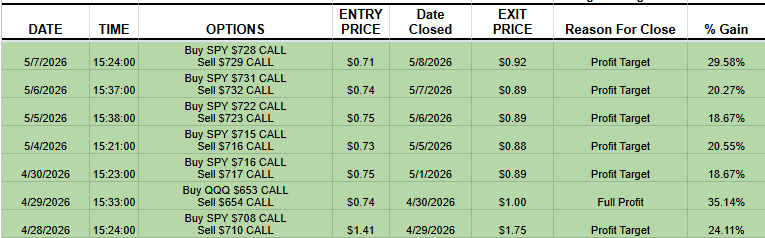
That’s seven consecutive times where they were able to collect payouts worth 25% on average overnight.
Now, I can’t make absolute guarantees on the market here…
But if all goes as planned, we might keep this streak going as we continue into May.
We’re already lining up new trades, and if you’d like to see how you can join the next overnight opportunity…
Disclaimer: We develop tools and strategies to the best of our ability but no one can guarantee the future. There is always a risk of loss when trading. Past performance is not indicative of future results. From 10/02/24 to 05/07/26, the win rate was 84.3% on live published trades. The average return on option trades was 2.65% over a one-day holding period, with an average winner of 19.73%.