🚨 I’ll be live at 10 a.m. ET with Graham Lindman🚨
It’s almost time for Friday Focus: You all pick a stock in my Telegram channel and we see if it’s a genius play or a trap. We’ll also cover Graham’s weekly gold trade and more [tap to join us for Opening Playbook]
You know what I love? When the market gives you crystal-clear boundaries to work with. And Monday, I got exactly that — thanks to a 7 a.m. premarket Trump candle that basically drew the battle lines for the entire range we’ve been trading in…
Early Monday morning, there was this massive candle on the S&P 500 (SPY) that came out of nowhere. The bottom of that candle was the market pricing in bad war news, and the top was good war news getting priced in.
What makes moves like this so powerful is how Wall Street reacts to sudden uncertainty. When news hits, traders scramble — buying calls can force the market higher, while buying puts can pressure it lower.
When you get a large, news-driven candle like that, it reveals exactly where those pressures are sitting.
Ever since that candle printed, the market has been trying to figure out where we actually are inside that range — closer to the bad news scenario or the good news scenario.
The range has been wide, but the net movement hasn’t been, with price chopping between those levels without a clear breakout. That’s when I started building a position…
Building the Iron Condor One Leg at a Time
Most traders will tell you to put on an iron condor all at once, but I prefer a more tactical approach — especially when the range is clearly defined.
When SPY pushed up to $660, I sold a call spread above that level. Then I waited, and when it dropped to the lower boundary, I sold a put spread.
Just like that, I had an iron condor, but I built it one leg at a time — selling premium at the extremes instead of guessing direction. The structure meant that as long as SPY stayed between $655 and $659, I could make about $5,000 on $2,500 of risk, a clean 2-to-1 reward-to-risk setup.
With 28 minutes to expiration, I was sitting on roughly $4,000 in profit. At that point, the question wasn’t whether the trade would work — it was whether to lock in gains or wait for the full payout.
The Final Few Minutes
Here’s where it got interesting. The position was showing about 99.5% profit, but it wasn’t filling at my target price. I kept trying to close it out, but the market wouldn’t give me a fill, which forced a decision in real time.
Do you take the money and walk, or hold and risk it for the last few minutes? I kept adjusting my exit lower, trying to get filled as time ticked away, thinking, “I’ll crawl it down and see what I can get.”
And in the end, it never filled — so I closed out at the full $5,000. The trade went from debating a $4,000 exit to capturing the entire move simply by staying in position.
Sometimes being a little greedy pays off, but the real takeaway isn’t the outcome — it’s the process. This wasn’t luck. It was about recognizing a range, respecting clear boundaries, and building a structure that benefits from indecision.
That 7 a.m. candle provided the framework, and instead of predicting direction, I traded the extremes. As I always say: “No, absolutely not. You and I know, all smart investors know, there’s no such thing as winning 100% of the time.” That’s why setups like this matter — defined risk, clear edges, and the discipline to execute when the market gives you structure.
Bonus! Iron Condor Guide: A Practical Blueprint
An iron condor isn’t a “safety box” — it’s a probability play. You’re selling premium at levels the market is unlikely to reach, and managing risk if it does.
1. Define the Range
Identify where price is “stretched” using support and resistance or volatility extremes. You aren’t looking for perfection — you’re looking for boundaries where price is least likely to settle by expiration.
2. Build the Wings
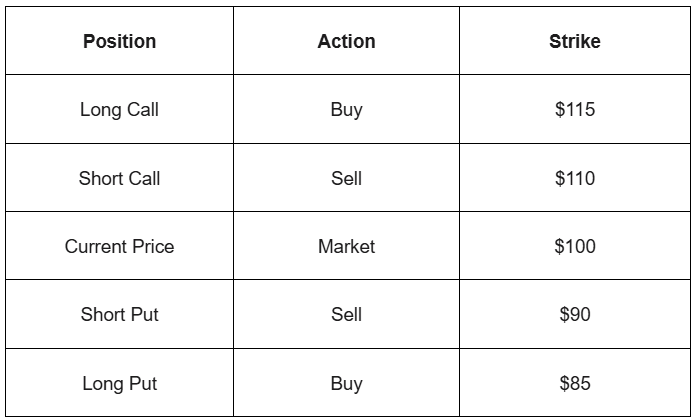
Construct two credit spreads around the current price to collect premium from both directions:
The Floor (Bull Put Spread): Sell a put below the market and buy a lower put for protection.
The Ceiling (Bear Call Spread): Sell a call above the market and buy a higher call for protection.
The Structure $100 Stock Example)
3. Calculate Risk and Reward
Max Profit: The total credit received upfront.
Max Risk: (Width of one spread) — (Total credit).
Efficiency: Because the stock can’t be in two places at once, you only post margin for one side, making this highly capital-efficient.
4. Execute the Exit
Don’t get greedy. While you can hold until expiration, most successful traders close the position at 50% to 75% of max profit to avoid late-stage volatility.
Now don’t forget to join us at 10 a.m. ET weekdays for Opening Playbook, and at 3:30 p.m. ET Closing Playbook!
Nate Tucci
Tucci Trades
Follow along and join the conversation for real-time analysis, trade ideas, market insights and more!
- Telegram: https://t.me/nate_tucci
- YouTube: https://www.youtube.com/@NewMoneyCrew
Important Note: No one from the New Money Crew team or Tucci Trades will ever contact you directly on Telegram.
*This is for informational and educational purposes only. There is inherent risk in trading, so trade at your own risk.
P.S. Get Your Hands on My Income Secret for Free
If you’ve been on the fence about my Income Secret…
Now might be the time to get your hands on the secret completely FREE.
For months now, folks have been using this same Income Secret for themselves…
Without the hassle of overthinking about what setup to trade…
Without stressing about portfolio size…
And without being overwhelmed about how long to hold a position before they exit!
Allowing them to target healthy gains depending on their risk preference and desired approach.
Today, I’m handing you free access to my Income Secret.
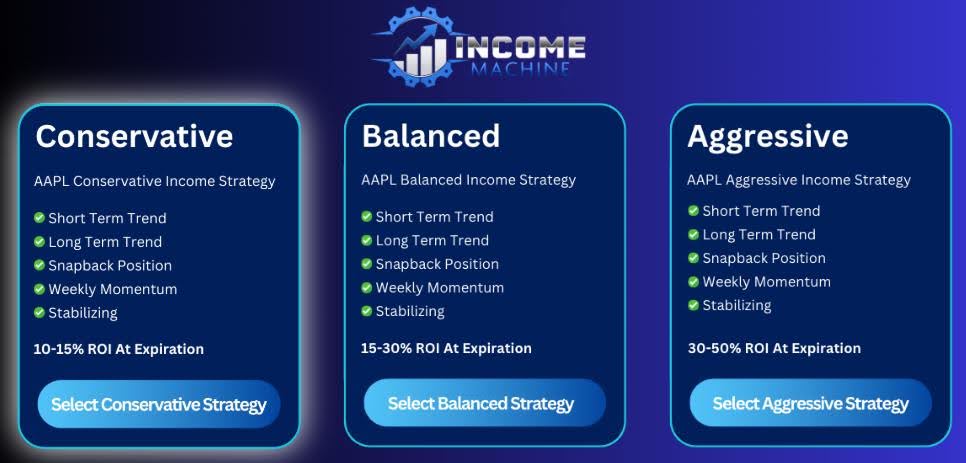
Even better, you’ll see the market phenomenon powering the income secret.
Of course I can’t make guarantees on the market…
But if you’d like to get started on the Income Secret as soon as today…
Here’s Where to Go for Free Access
Disclaimer: We develop tools and strategies to the best of our ability, but no one can guarantee the future. There is always a risk of loss when trading. Past performance is not indicative of future results. While we have used the Income Machine with great success, we cannot guarantee future results. What you will see today are some of the best examples over the last few months. There were bigger winners, smaller winners, and losers. Since the Income Machine is a tool for traders and not a trading service, profits and performance will vary among users.