
🚨 I’ll be live at 10 a.m. ET with Graham Lindman🚨
Why do all the heavy lifting yourself? The biggest players spend millions on research. We’re showing you how to just read their homework [tap to join us for Opening Playbook]
Sometimes you find a setup that’s just too good to play only one way.
That’s where I’m at with Walt Disney (DIS) right now.
The chart looks pretty dicey — and by that I mean it’s setting up for a potential move lower. We look like we want to break through into open space, which could trigger another leg down.
But here’s the thing: DIS has also been moving enough to create unusual premium opportunities.
Instead of picking one trade and hoping it works, I’m laddering multiple structures together — one defensive, one aggressive and a middle-ground play if pricing makes sense.
Same underlying, different risk profiles.
Let me walk you through it.
The Defensive Play
The first layer is a put spread at the $106–$107 strikes.
DIS is trading around $105, so these strikes are above the current price. That gives roughly a 1% cushion before the trade even starts working.
I’m collecting 52-54 cents on this structure — close to 100% ROI.
That’s not typical. Normally you’re looking at something closer to 30% ROI.
But with volatility elevated, the market is paying more than usual for a trade that already has built-in room for error.
That’s why I stepped in.
The Aggressive Play
If DIS breaks lower like the chart suggests, there are gamma pocket levels around $96-$97 into the March 6 expiration.
If price moves into that zone, the structure can push toward 300% ROI on conservative pricing. If it flushes deeper into $96, the upside expands quickly.
But this isn’t a standalone swing-for-the-fences trade. It’s one rung in a layered approach.
You can also split the difference with something like a $101 put spread.
If DIS simply tags recent local lows, you can still generate strong returns without needing a full breakdown.
Flexibility is the edge here.
How Laddering the Structures Works
Think of it like building rungs on a ladder.
At the top, you’ve got the $106-$107 spread — high probability and unusually strong income.
In the middle, a $101-targeted spread offers solid payoff without requiring a dramatic move.
At the bottom, the $96-$97 zone provides asymmetric upside if the breakdown accelerates.
All three can be managed together.
You get the cushion of the defensive play, the juice of the middle and the explosive potential of the aggressive structure — without overcommitting to any single outcome.
That’s the advantage of structuring it this way.
When you find a setup this good, sometimes the best move is to play it more than one way.
Now don’t forget to join us at 10 a.m. ET weekdays for Opening Playbook, and at 3:30 p.m. ET Closing Playbook!
Nate Tucci
Tucci Trades
You can also follow along and join the conversation for real-time analysis, trade ideas, market insights and more in my official Telegram channel!
Important Note: No one from the New Money Crew team or Tucci Trades will ever contact you directly on Telegram.
*This is for informational and educational purposes only. There is inherent risk in trading, so trade at your own risk.
Want A Shot At A Deposit In Your Account By Tomorrow?
There’s almost nothing better than waking up to fresh deposits in your account.
I know this because traders who were in on my No. 1 overnight setup have received 8 of those deposits in a row.
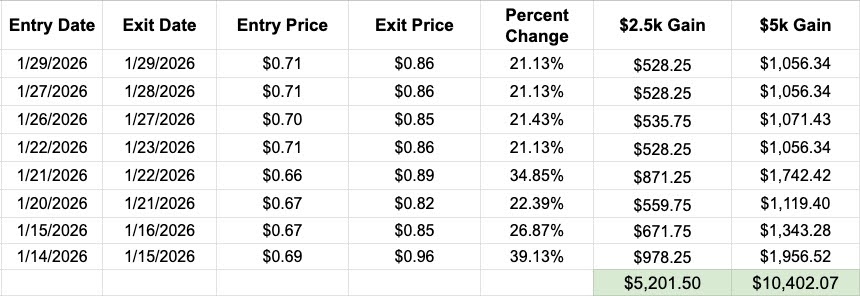
That’s eight consecutive times where they collected payouts worth 25% on average overnight.
Now, I can’t make absolute guarantees on the market here…
But if all goes as planned, we might keep this streak up in February.
We’re already lining new trades up for this week, and if you’d like to see how you can join the next overnight opportunity…
Disclaimer: We develop tools and strategies to the best of our ability but no one can guarantee the future. There is always a risk of loss when trading. Past performance is not indicative of future results. From 10/02/24 to 01/29/26, the average win rate was 80.2% on live published trades. The average return on options trades was 1.95 % over a one-day hold time, with an average winner of 23.88%