🚨 I’ll be live at 10 a.m. ET with Graham Lindman🚨
Kane is joining Graham and me for the Opening Playbook at 10AM ET. He’s showing us how he filters the early morning chaos. It’s a masterclass in logic [tap to join us for Opening Playbook]
Ever have one of those days where the market looks down, but it’s actually up?
I know that sounds weird, but stick with me for a second.
I was looking at the market on Tuesday, and something caught my eye that I think a lot of traders completely missed. The S&P 500 (SPY) closed red, down about 0.24% at $7,109.14.
But the Equal Weight S&P 500 (RSP) still showed relative strength, highlighting what was happening beneath the surface.
That’s a divergence. And it tells you a lot more about what’s really happening under the hood than just looking at the headline number.
What you’re seeing is net neutrality between the broad market getting a little healthier but the risk on names coming down a bit. In other words, the market wanted to go up, but a handful of stocks held it back.
And guess who those stocks were?
The Magnificent Seven (MAG7).
When the Biggest Names Drag the Market Down
The MAG7 stocks were broadly lower on the day, but the weakness wasn’t uniform. Apple was the outlier, gaining about 1.04%, while names like Nvidia and Tesla dropped more than 1%.
And because these names carry so much weight, they dragged the index lower. Even the Nasdaq 100 (QQQ) underperformed, with QQQ closing down about 0.31%, lagging SPY on the session.
But here’s the key point: The weakness was concentrated, not broad based.
Everything else was holding up just fine. It was really just those seven names pulling things lower. And that’s actually not a bad thing.
Why This Rotation Matters
The real story showed up in the Russell 2000 (IWM), which hit a record high of $2,792.96, up about 0.58%. That’s where the rotation becomes obvious.
When you see small caps pushing to new highs while mega caps cool off, it’s a sign that money is rotating, not leaving. It’s broadening out across the market instead of concentrating in a handful of names.
We also saw something important beneath the surface: the CBOE Volatility Index spiked sharply, jumping as much as 10.5% intraday.
Moves like that signal uncertainty, but they often show up in markets that are still structurally bullish. It tells you traders are actively hedging while the broader market continues to hold together.
Another piece of the puzzle is sector participation. When previously lagging areas start to strengthen alongside small caps, it reinforces the idea that the market foundation is improving, not deteriorating.
And then there’s the influence of 0DTE options. These contracts now carry so much weight that they can steer SPX action most days of the week.
When you combine that with sector rotation and strong underlying participation, divergences like SPY red and broader strength become far more meaningful.
So even though the headline numbers looked weak, the underlying structure was actually solid. The market wanted to go higher. It was just the MAG7 showing signs of rotation.
And that’s the kind of shift I like to see when I’m looking for confirmation that bullish momentum can hold. It’s not just about what SPY did, it’s about what the broader market is signaling underneath.
Now don’t forget to join us at 10 a.m. ET weekdays for Opening Playbook, and at 3:30 p.m. ET Closing Playbook!
Nate Tucci
Tucci Trades
Follow along and join the conversation for real-time analysis, trade ideas, market insights and more!
- Telegram: https://t.me/nate_tucci
- YouTube: https://www.youtube.com/@NewMoneyCrew
Important Note: No one from the New Money Crew team or Tucci Trades will ever contact you directly on Telegram.
*This is for informational and educational purposes only. There is inherent risk in trading, so trade at your own risk.
P.S. We’re Going After My 100th Trade — Killing a Bird With 2 Stones
I’ve been deploying a unique approach to the market for at least 15 months. One that allows me target cash whichever direction the market or the stock decides to go.
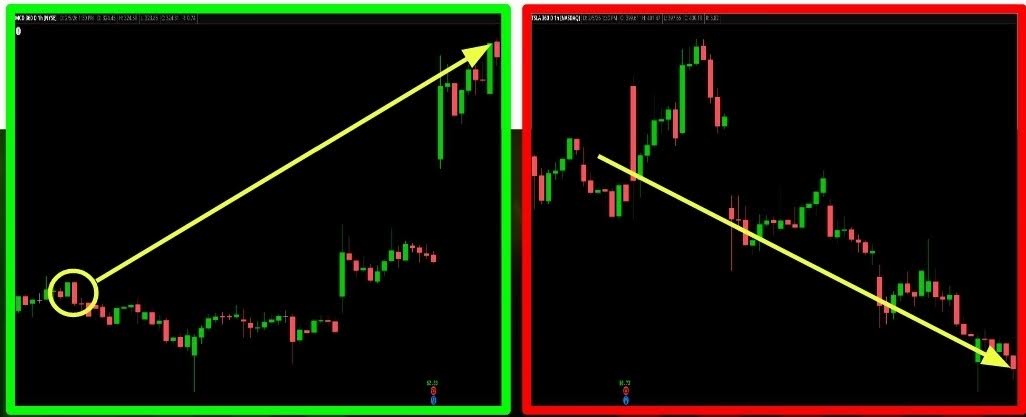
The next opportunity opening up right now is our 100th trade and I would like you to join in on the milestone with me.
Disclaimer: We develop tools and strategies to the best of our ability, but no one can guarantee the future. There is always a risk of loss when trading past performance is not indicative of future results. Since 1/12/24, the strategy has issued 99 closed trades, for a total win rate of 72.8%. The average gain, winners and losers included, has been 5.12% per trade over an average holding period of 20 days.