
🚨I’ll be live at 10 a.m. ET with Graham🚨
We’ll take top-down look at the market and I have a watchlist of my favorite catch-up stocks, look for a live two-way trade and more [tap to join us for Opening Playbook]
There’s a question I get all the time: Do I trade based on seasonality?
And the answer is … sort of.
I would never buy a stock just because it has a seasonal pattern. That would be a hard no for me.
But if I already like a stock, already see a setup, already have a reason to be in it? Then yeah, I’ll use seasonality as an odds enhancer.
This was another major discussion during our Summer Stock Roundtable because seasonality is one of the most misunderstood concepts in trading.
We spent some time breaking down why these patterns exist, how institutions create them and how traders can use them without falling into the average trap. If you want to watch the entire discussion, click here.
Most traders miss why seasonality exists in the first place. These patterns don’t appear out of thin air.
Markets move in rhythms because people and institutions move in rhythms. Liquidity slows down at predictable points, pension funds rebalance in predictable windows and 401(k) contributions hit the market on predictable schedules.
Entire industries move in cycles — semiconductors react to product releases, agricultural names follow the summer season and advertising budgets spike at the same points every year. When behavior repeats, price often repeats too.
It’s the same idea as walking past the same group of people sipping coffee every morning. They’re not copying each other, but they follow similar routines, so the action repeats. Markets behave the same way.
The Problem With Averages
One of the biggest mistakes I see traders make with seasonality is not understanding how averages actually work. If a stock goes up an average of 3% every September, that might be the result of one giant outlier and a lot of mediocre or losing months.
So instead of chasing the average, real pros look for patterns backed by both logic and consistency — a stock trending higher over six months and a seasonal window that’s hit nine out of the last 10 years. When you find something that strong and the date is coming up, that’s a very different conversation.
And even then, it has to make sense. Energy tends to run when demand is high. Retail names often move around holidays. Tech often ramps into major launches. If the pattern feels wacky or disconnected from the real world, I’m out.
This is also where portfolio context matters. A seasonal edge isn’t a free pass to overload a sector you’re already heavy in. If it doesn’t fit your current exposure, you shouldn’t take the trade — even if the pattern is good.
How I Actually Use It
When seasonality lines up with a strong stock in a strong market, that’s when I pay attention. But I still keep the trade structure conservative.
I never want to see a stock go up 2% in my direction and still lose money because I reached for aggressive out-of-the-money (OTM) options.
I’d rather build something tight, something with lower leverage, something that pays me on a small move.
The best trades are the ones where multiple edges stack — a solid trend, a clean setup and a seasonal tailwind all pushing the same direction. And because most seasonal opportunities play out in short bursts, the window is usually eight to 10 days, not months. This is a trader’s tool, not an investor’s timeline.
Before acting, ask a few simple questions: Does the pattern make economic sense? Does the business line up with the cycle? Do institutions have a reason to move money that way? If the answer is no, it’s likely just noise.
Hope this helps,
Now don’t forget to join us at 10 a.m. ET weekdays for Opening Playbook, and at 3:30 p.m. ET Closing Playbook!
Nate Tucci
Tucci Trades
Follow along and join the conversation for real-time analysis, trade ideas, market insights and more!
- Telegram: https://t.me/nate_tucci
- YouTube: https://www.youtube.com/@NewMoneyCrew
Important Note: No one from the New Money Crew team or Tucci Trades will ever contact you directly on Telegram.
*This is for informational and educational purposes only. There is inherent risk in trading, so trade at your own risk.
P.S. I Have an Overnight Breakthrough to Show You
There’s almost nothing better than waking up to fresh deposits in your account.
I know this because traders who were in on my no. 1 overnight setup have received the opportunity to see seven consecutive deposits.
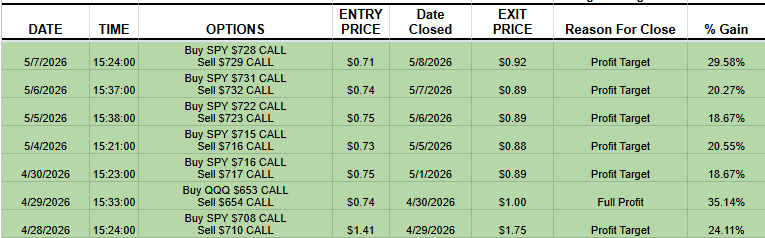
That’s seven consecutive times where they were able to collect payouts worth 25% on average overnight.
Now, I can’t make absolute guarantees on the market here…
But if all goes as planned, we might keep this streak going as we continue into May.
We’re already lining up new trades, and if you’d like to see how you can join the next overnight opportunity…
Disclaimer: We develop tools and strategies to the best of our ability but no one can guarantee the future. There is always a risk of loss when trading. Past performance is not indicative of future results. From 10/02/24 to 05/07/26, the win rate was 84.3% on live published trades. The average return on option trades was 2.65% over a one-day holding period, with an average winner of 19.73%.