
🚨 I’ll be live at 10 a.m. ET with Nate Tucci🚨
[tap to join us for Opening Playbook]!
There’s a key difference between call spreads and put spreads that most traders do not think about until it’s too late — and it has everything to do with what happens if you get assigned early.
When you’re at or slightly out of the money, using calls flips the entire risk profile. If you get exercised early with puts, you take a max loser. If you get exercised early with calls, you lock in a max winner.
That’s a built-in advantage I want working for me, not against me.
And all of this only works if you stay in the game. Controlling your risk will keep you in the game, and the structures you choose matter. Calls at the money give you a structural benefit that simply does not exist on the put side.
The Trade Setup I’m Using for This Cycle
Let’s discuss an example…
A couple of weeks ago I put on a wrap order for the May 1 expiration: I bought the $410 and sold the $411. That gave it a full month for gold to gain just 50 cents — a tiny 0.12% move.
You do not need momentum, breakouts or some big macro tailwind. You just need gold to not fall apart. And as of late Friday, GLD was above $437.
I targeted around 50 cents on the debit. At that price, with 40 contracts, I risked $2,000 to make $2,000. Clean, symmetrical and built on almost no required movement from the underlying.
The beauty of these call spreads is that they don’t require you to nail timing or ride massive moves. You set up a defined-risk, defined-reward position, lean on structural advantages like favorable early assignment dynamics and let the probabilities do the heavy lifting.
That’s the whole point of using smart, repeatable structures instead of chasing setups.
Why I’m Adjusting My Risk Level
Before the recent drop in gold, I was going for about $500 a week on these trades. After the pullback, I’ve shifted back to keeping my risk level around $2,000 a week, which is what I had been running before — and it’s going to pay me a bit more.
Nothing reckless, just sizing responsibly based on the setup and volatility.
When you combine tight risk control, systematic execution and a trade structure that flips early assignment risk in your favor, you end up with a strategy that doesn’t need drama to perform.
It just needs repetition.
If you’ve been ignoring call spreads for income trades, especially around the money, it might be time to rethink that. The edge is real — and it compounds when applied consistently.
Graham Lindman
Graham Lindman Trading
Follow along and join the conversation for real-time analysis, trade ideas, market insights and more!
- Telegram:https://t.me/+abM5RWRJKrpkNWI5
- YouTube:https://www.youtube.com/@NewMoneyCrew
Important Note: No one from the ProsperityPub team or Graham Lindman Trading will ever contact you directly on Telegram.
*This is for informational and educational purposes only. There is inherent risk in trading, so trade at your own risk.
P.S. My No. 1 Daily setup and What Happens When You Hold Till the Close
I’ve been showing everyone how to target 50% a day in less than an hour…
Every morning using my No. 1 daily setup.
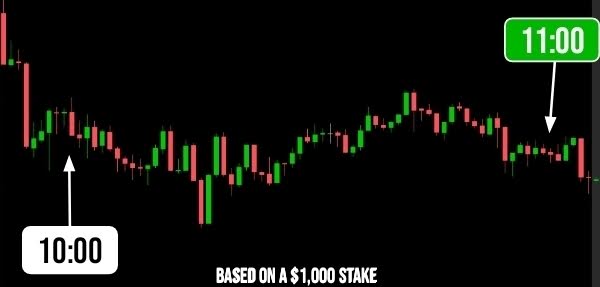
However, if you hold the same trade until the close, that 50% target quickly transforms into what could be a 100% payout!