🚨 I’ll be live at 10 a.m. ET with Nate Tucci🚨
We’ll cover the morning market update, a hot stock JPMorgan just added a massive position, rising market breadth, earnings and more [tap to join us for Opening Playbook]!
If you’ve ever struggled with when to enter a momentum trade — or worse, when to exit one — I’ve got a way of thinking about it that might finally make it click.
I use an airplane analogy, and once you see it this way, you won’t look at momentum the same.
Think about an airplane sitting on the tarmac. It’s stationary — no movement, no momentum.
That’s exactly what a stock looks like when momentum is negative or neutral. It’s parked, nothing’s happening and it’s definitely not the time to be buying calls or accumulating shares.
Then the engines start roaring and the plane begins to gain speed. That’s like when the five-day exponential-moving-average (EMA) first crosses the 16-day EMA, and an above-average reading shows up.
This is when I want to enter — when we first flip to green and expansion hits 1% or more. After that, the plane starts climbing faster, and that’s when we see the big momentum moves.
You can ride these as long as the stock keeps accelerating at that above-average momentum and stays green.
The Climb — Where the Big Moves Happen
This is the phase most traders either miss or exit too early. They get nervous or take profits on the first pullback.
But if momentum is still expanding and still green, the plane is still climbing. You don’t jump out of a plane gaining altitude — you stay with it and let it run.
One thing that helps during this phase is knowing where the strength is coming from. For bullish long swing trades, you want exposure to strong sectors — both seasonally and currently.
That’s why I walk through them during the weekly market breakdown. It helps you focus on areas that naturally support stronger momentum moves.
The Landing — When It’s Time to Take Profits
Eventually the climb slows and the plane starts preparing for landing. That’s when momentum decelerates, expansion shrinks and profit-taking becomes the priority.
As the plane begins to slow and flips back to yellow, that’s when I take profits. You don’t wait for the crash — you exit with control.
This framework works cleanly for stock trading. For options, where your time window is tighter, you may trade the swings more aggressively — but the foundation stays the same.
Buy on green, sell on yellow or red and always stay aware of the sector backdrop. Once you understand which phase the airplane is in — parked, accelerating, climbing or landing — the decisions get a whole lot easier.
Graham Lindman
Graham Lindman Trading
Follow along and join the conversation for real-time analysis, trade ideas, market insights and more!
- Telegram: https://t.me/+abM5RWRJKrpkNWI5
- YouTube: https://www.youtube.com/@NewMoneyCrew
Important Note: No one from the ProsperityPub team or Graham Lindman Trading will ever contact you directly on Telegram.
*This is for informational and educational purposes only. There is inherent risk in trading, so trade at your own risk.
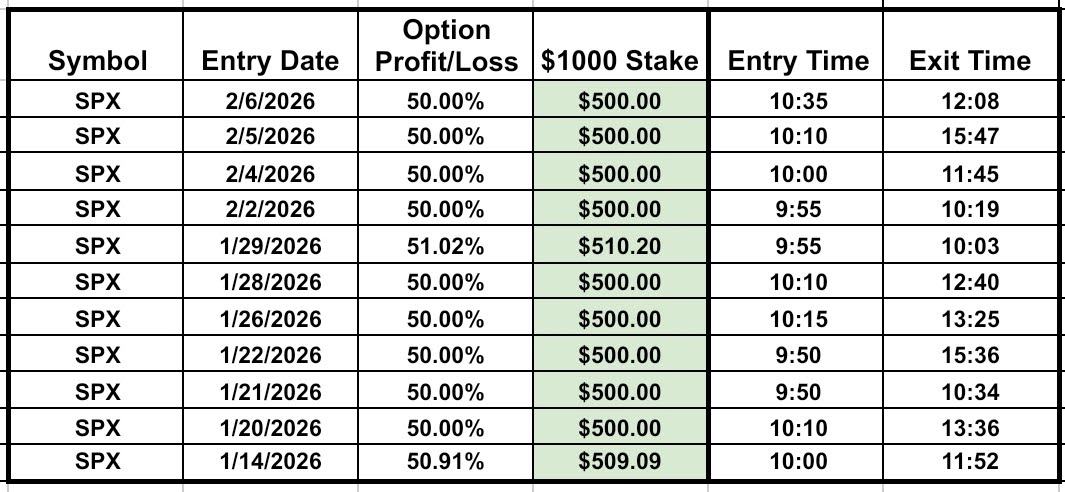
P.S. My Daily SPX Trade Has Won 10 Consecutive Trades
Anyone who’s been in on this unique daily trade would currently have an extra $5,000 in their pocket with just $1,000 stake on each trade.
I’m gearing up to take the next one tomorrow morning.
Disclaimer: We develop tools and strategies to the best of our ability, but no one can guarantee the future. There is always a risk of loss when trading; past performance is not indicative of future results. The results on live trades published in real time during 6/20/2025 – 2/06/2026 produced an 77.7% win rate with an average return of 17.89% for the same hold time.