
🚨I’ll be live at 10 a.m. ET with Nate🚨
We’ll step inside the space stock command center, break down how you can get a piece of tonight’s $1,000 giveaway, and head straight to the charts for a live day trading session with our special guest, Roger Scott [tap to join us for Opening Playbook]
I need to show you something that might completely change how you think about options trading.
Most traders reach for straight call options when they want to play a bullish move. It seems logical: You think a stock is going higher, so you buy a call and wait for the profit.
But here’s what nobody tells you: Those straight call options can cost up to eight times more than a structured debit spread, forcing you to pay for massive, explosive upside that you don’t even need for a normal market move.
To make this real, look at a recent pricing snapshot on Apple (AAPL):
- Bull Call Debit Spread Cost: $218
- Deep In-The-Money Straight Call Option: $1,675
The straight call costs roughly eight times more to take a directional bet on the exact same stock. This drastically changes how your capital behaves and how much risk you absorb upfront.
The Cost Problem Nobody Talks About
If AAPL gains just 3% over two months, a properly structured, tight debit spread can yield a 129% return at expiration.
Meanwhile, that same modest 3% move produces a dramatically lower return for the straight call holder. Why? Because you are fighting a massive uphill battle against time decay.
When you use a spread instead of a straight call, the math completely flips in your favor:
- Lower Capital Outlay: You risk significantly less money upfront to control the same underlying move.
- Time Decay Offset: By selling an out-of-the-money call against the one you buy, the time decay you collect on the short leg helps neutralize the decay on the option you own.
- Bigger Payouts on Smaller Moves: You don’t need a massive, vertical breakout to hit max profit.
A common trading myth is that higher cost equals higher reward. The reality is often the opposite. With a straight call, you risk more capital for a lower percentage return on modest moves.
Sure, if the stock explodes vertically in the very first week, a straight call gives you a great immediate percentage pop. But what if the stock takes its time?
If it takes a month to grind to your target, time decay eats your straight call’s profit down to 32%. If it takes until expiration, you could be completely right about the stock’s direction and still walk away with a net loss.
The debit spread, however, thrives as that clock ticks down, sucking the value out of the leg you sold.
Applying the Math Beyond Apple (AAPL)
This structure shines across the entire market, especially on heavy-hitting blue chips. Take a recent setup analyzed on Amazon (AMZN) with the stock trading near the $266 zone.
If you buy a tight, $1.50-wide debit spread for $0.72, AMZN only needs to gain a microscopic 0.5% to push above $267.50 by expiration. If it sits even one penny above that level at the closing bell, the spread expands to its full $1.50 value.
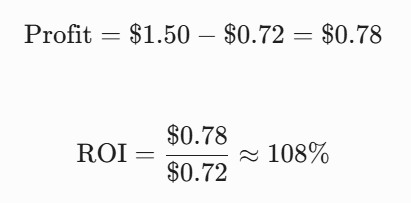
Instead of betting on a massive, statistically rare breakout, you are leveraging a highly structured trade designed to harvest triple-digit returns from minimal upward movement.
Strategy Over Emotion
None of this is financial advice or a directive on what to trade. This is about process.
Many traders prefer to manage risk mechanically, exiting spreads early at a fixed 50% or 70% profit target to take time risk off the table, while others hold closer to expiration to capture the full structural value.
Your approach should always match your personal risk profile and playbook.
The takeaway is simple: Your emotions will lie to you, but math won’t.
Rely on systematic structures, historical win rates, and probability data to stay on the right side of the ledger.
Stop overpaying for straight calls when spreads can do the heavy lifting for a fraction of the cost.
Graham Lindman
Graham Lindman Trading
Follow along and join the conversation for real-time analysis, trade ideas, market insights and more!
- Telegram:https://t.me/+abM5RWRJKrpkNWI5
- YouTube:https://www.youtube.com/@NewMoneyCrew
Important Note: No one from the ProsperityPub team or Graham Lindman Trading will ever contact you directly on Telegram.
Also check out my website at: https://grahamlindman.com/!
P.S. If You Missed Our Live Pattern Day Trading Roundtable…
If you missed the Pattern Day Trading roundtable this week…
Where I joined Roger Scott, Nate Tucci, and Kane Shieh to break down the new reality facing retail traders in June…
There’s a good chance you’re still underestimating how dramatically the market environment could shift starting next month.

Because this isn’t just another broker update.
The removal of long-standing PDT restrictions could fundamentally change how smaller accounts participate intraday.
I’m talking:
- More retail flow.
- Faster rotations.
- More aggressive momentum bursts.
- And potentially far more volatility during the trading day.
That’s why we made sure to reveal exactly how anyone with a small account can thrive in this coming market.
No trading guarantees, of course…
But everyone who showed up left with 4 of the best setups perfectly suited for the new trading environment…
Including my No. 1 daily setup.
So if you’d like to quickly catch up before the heat starts building…