
🚨I’ll be live at 11 a.m. ET🚨
After going 4-for-4 this week and extending our 2PM Income win streak to 19 trades (*full track record listed below), I’m reopening enrollment for TODAY ONLY and going live to break down today’s setup! [tap to join us]!
Here’s something that might go against everything you’ve heard about managing options trades: I typically hold till expiration with spreads.
While most traders rush to close profitable positions early, I’ve developed a systematic approach that prioritizes cost efficiency over quick profit-taking. The foundation of my strategy comes down to one simple principle — I use puts because I don’t want to pay closing fees, and I don’t want to have to pay exercising fees.
This isn’t about being cheap — it’s about maximizing a mathematical edge over time.
This also means understanding risk at a deeper level. Traders often ask how many contracts are needed to hit a certain profit target, but if you’re asking that question without first knowing the risk math, you’re already off balance.
You need to know your risk before you get into the trade, not after. That mindset is core to everything I teach and every position I take.
The Set-and-Forget Philosophy
My approach centers around bull put credit spreads, where if the underlying closes above the strike, the position simply disappears from my account without any additional fees.
A recent gold setup required adjusting strikes up to $394 after a meaningful move, but the principle stayed the same. I do not set targets. I let the trade work and aim for full expiration.
When spreads expire out of the money (OTM), they vanish — no closing costs, no exercise fees, no extra decisions. After that first reference, I simply call them OTM.
This isn’t limited to gold either. I test this approach across multiple assets to strengthen the strategy. For example, when reviewing performance across markets, one of the cleanest datasets came from the Nasdaq 100 (QQQ), which produced some of the best results overall.
That kind of cross-market testing reinforces that the method isn’t tied to a single chart or commodity.
And even within this set-and-forget style, there’s room for real-time judgment. Market conditions shift, and sometimes you’re watching the screen thinking, “Let’s see what the next move tells us.”
That moment-to-moment awareness helps guide adjustments without abandoning the broader framework.
When to Break the Rules
There is exactly one scenario where I manually intervene: when the underlying finishes between the two strikes, creating assignment risk. If you’re holding a spread with strikes like $384 and $385 and the price closes at 384.50, you can be assigned.
In those cases, if the market is threatening your strikes heading into expiration day, it’s often better to close the position manually and avoid assignment altogether.
This methodology isn’t for everyone and it shouldn’t be. But for traders who appreciate cost efficiency, statistical advantage and simplicity, holding credit spreads to expiration continues to be a compelling, durable approach.
P.S. I have another way to trade credit spreads that you don’t have to worry about assignment at all — income spreads on index options. I’ll be live at 11 a.m. ET today to share the strategy that’s won 19 straight trades and only lost once so far at 11 a.m. ET today!
Graham Lindman
Graham Lindman Trading
Follow along and join the conversation for real-time analysis, trade ideas, market insights and more!
- Telegram:https://t.me/+abM5RWRJKrpkNWI5
- YouTube:https://www.youtube.com/@NewMoneyCrew
Important Note: No one from the ProsperityPub team or Graham Lindman Trading will ever contact you directly on Telegram.
*This is for informational and educational purposes only. There is inherent risk in trading, so trade at your own risk.
P.S. 4 for 4 This Week — Will Today Be a Clean Sweep?
All right folks… We are 4/4 on 2PM Income trades this week, and on a 19-trade win streak!
If someone had started with $5K on each of our trades this week, you could already be up $2,621 in total profits!
Earlier this week, I closed down enrollment for folks that wanted to trade this system. I wanted to onboard everyone that had just signed up and do live trade rooms every day to make sure everyone fully understood the setup…
But now that we have still yet to lose a trade and CRUSHED this week, I want to give folks a second chance opportunity — TODAY ONLY!
So I’ve decided to host a session here at 11 a.m. ET this morning to show folks how to get into today’s 2PM Income setup…
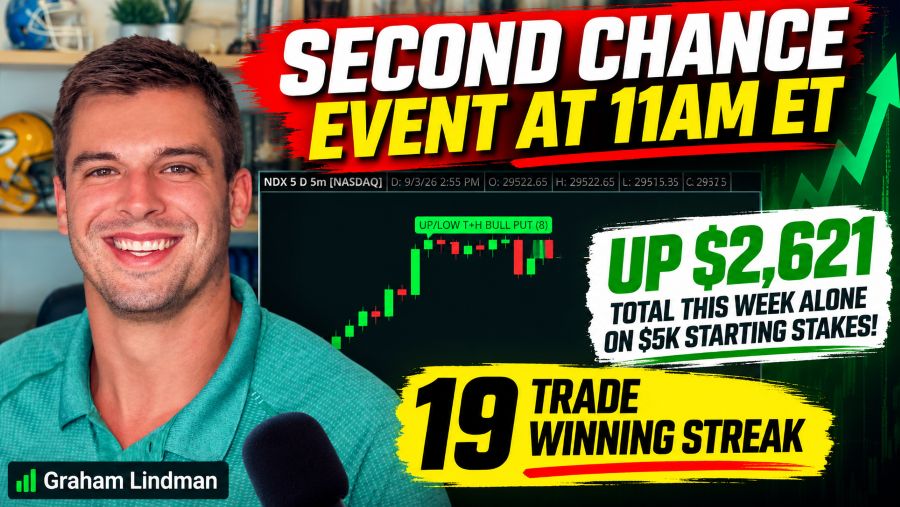
And if it’s anything like the four other trades we’ve taken so far this week, I hope it’ll be another nice winner! No guarantees, of course, but that’s the idea.
*The profits and performance shown are not typical, we make no future earnings claims, and you may lose money. From 07/15/2026 through 09/03/2026, the win rate is 95.7% with 22 wins and just one loss, and the average return per position including both winners and losers is 14.16% with an average hold time of two hours.