🚨 Don’t Miss our SpaceX IPO event 🚨
Join me Graham, Nate and Alex live at 10 a.m. ET TODAY for our SpaceX IPO Event, where we’ll reveal how to target smaller, little-known companies positioned to ride the massive space-investing stampede around Elon Musk’s historic IPO [tap to join us]!
There’s a question I keep getting asked: When does this AI rally finally run out of steam?
Everyone wants to call the top. They see valuations stretched, they hear about bubble conditions and they start getting nervous. But most of the analysis I’m seeing misses the most important factor…
I’ve been saying this for a while now, and I want to lay it out clearly: The true bear case isn’t sentiment or valuations — it’s when the Magnificent Seven companies run out of free cash flow.
That’s the moment when the spending goes basically to zero. When that happens, contracts get cancelled, CapEx gets pulled back and all the infrastructure stocks riding this AI wave — names like Micron (MU), SanDisk (WDC), Bloom Energy (BE) and others — are going to feel real pain. These are the riders benefiting directly from Mag7 capital, so when the money slows, they’ll be the first to show cracks.
The Free Cash Flow Problem Is Already Here
I recently came across a chart tracking free cash flow for Oracle (ORCL), Meta (META), Google (GOOGL), Amazon (AMZN) and Microsoft (MSFT). The trend is unmistakable…
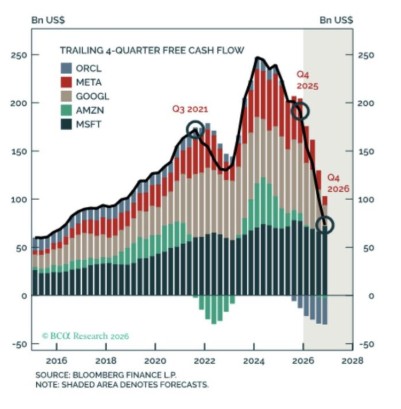
Since 2024, these companies have been spending money faster than they’re making it. Their free cash flow has been declining quarter after quarter.
Google is already at zero or negative free cash flow. That’s why the company had to sell stock to raise more capital. Meta is in the same boat — it’s out of money and selling stock too. Oracle has been in negative territory for a while.
Microsoft still has quite a bit of free cash flow remaining, which gives the company more runway than the others.
While the trend is concerning, it’s important to remember that these companies can extend the timeline by selling additional stock to raise capital. That can temporarily refill the tank and keep the AI infrastructure buildout funded longer than the raw cash flow numbers suggest, which adds an unpredictable layer to how long this can run.
But here’s the key: When this free cash flow hits zero across the board and forces them to slow their AI infrastructure spending, that’s what causes the bubble to pop.
Orders get cancelled. CapEx gets slashed. And all the companies benefiting from this spending spree are going to see their deals evaporate.
This whole setup actually mirrors the late 1990s tech melt-up. Back then, the runway looked stretched but intact until free cash flow finally buckled — and the market didn’t break immediately.
The same kind of melt-up pattern is forming again, which reinforces the idea that even with deteriorating free cash flow today, there’s still room for the rally to push higher before anything truly breaks.
But We’ve Still Got Time
Now, before you start panicking or shorting everything in sight, let me give you the other side of this…
I don’t think we’re there just yet. I think we’ve got more runway here.
The chart I mentioned shows quarterly data. Based on what I’m seeing, I believe we’ve got another three to four quarters before anything like this becomes a real issue. That timeline lines up with what we’ve seen in previous melt-up environments, where markets can surge dramatically even as underlying fundamentals start to fade.
And remember, volatile swings and scary headlines are part of any late-stage rally. Sharp drawdowns can happen, sometimes fast, but they don’t necessarily signal the end. In this phase, the market punishes anyone who mistakes volatility for a top.
That’s also why I typically ignore the big “top calls” from Wall Street. They’re almost always early — sometimes by six months or more. They’ve been wrong consistently throughout this cycle, and leaning on those calls instead of real liquidity data can get investors shaken out too soon.
This is eventually going to be an issue — I’m not ignoring that. But it’s not an issue today and probably not for several more quarters. Until free cash flow truly dries up, the music keeps playing even if the tempo gets choppy.
So I’m watching this metric closely. It’s the one thing that will tell me when the music actually stops. Price action, news flow and analyst warnings are noisy. Free cash flow is the signal.
Now be sure to join us at 10 a.m. ET for today’s BIG SpaceX IPO event with myself, Lance, Nate and Alex! We’ll cover all things SpaceX and how we plan to profit from the rising tide that should lift all boats, including our top 7 stocks to trade alongside it!
Graham Lindman
Graham Lindman Trading
Follow along and join the conversation for real-time analysis, trade ideas, market insights and more!
- Telegram:https://t.me/+abM5RWRJKrpkNWI5
- YouTube:https://www.youtube.com/@NewMoneyCrew
Important Note: No one from the ProsperityPub team or Graham Lindman Trading will ever contact you directly on Telegram.
*This is for informational and educational purposes only. There is inherent risk in trading, so trade at your own risk.
P.S. LIVE AT 10 AM ET: The SpaceX Pre-IPO Event
If you haven’t already…
Tune in to The SpaceX Pre-IPO Event at 10 a.m. ET!
Lance, Nate, Alex and I are coming together to help you prepare for this once-in-a-lifetime IPO event – a day before!
There’s a massive investing stampede on the horizon, and we’ll make sure you’re sitting exactly where you need to be to get in on opportunities.

No trading guarantees, of course…
But you’ll see exactly how to take advantage the day of and weeks following…
Plus, you’ll be walking away with our top SEVEN stocks to watch as it all unfolds.
We’re getting started soon…