🚨 I’ll be live at with Alex at 2:30 p.m. ET🚨
Alex and I are tracking the market’s reaction to today’s Fed meeting in real time. We’re breaking down how to approach the dip in SPCX and revealing the key institutional flows we’re watching for the rest of this short week [tap to join us for Profit Panel]
Even with the paper market aggressively selling off on hopes of a Middle East peace deal, the prevailing optimism lacks structural support.
Algorithmic traders are racing to price in an overnight normalization of global trade, but that does not mean the underlying reality on the ground has changed. There is still no signed agreement on paper.
There is still no signed agreement on paper.
No one can say with absolute certainty who currently controls transit safety through the Strait of Hormuz, and until we see concrete operational frameworks — not just optimistic media headlines — nothing is guaranteed.
Phase One: Reopening the Strait Takes Time
Before dissecting the timelines, it is critical to ground this macro picture in physical reality.
Headlines can print whatever they want, but without signed agreements and real operational clarity in the Strait of Hormuz, maritime logistics do not move as quickly as paper traders believe.
Even in an absolute best-case scenario where leaders shake hands and declare a truce, reopening the Strait is a multiweek process.
You cannot simply flip a switch.
There are shipping lanes to clear and secure from potential hazards, insurance underwriters to coordinate with and complex logistical backlogs that will take considerable time to realign.
The initial knee-jerk market reaction acts as if the global energy supply chain can be fixed overnight, but the physical world does not move on the same accelerated schedule as a headline-driven algorithmic gap.
It will likely take a couple of weeks just to get standard commercial tanker traffic safely flowing through the chokepoint again — and that is before addressing the deeper fundamental destruction.
Phase Two: The Infrastructure Damage
The far more severe problem — and the exact one most momentum traders are overlooking — is the physical damage sustained by regional energy infrastructure.
A significant number of production wells, storage tanks and supporting export facilities across key hubs like Fujairah and the surrounding UAE infrastructure were hit during the conflict.
Those complex sites have to be rebuilt from the ground up, and there is no shortcut for heavy industrial reconstruction.
Rebuilding energy infrastructure requires specialized materials, engineering crews, rigorous safety inspections and synchronized timelines that push actual capacity restoration months into the future.
This creates a highly staggered recovery.
Reopening the shipping lanes is merely phase one; restoring actual production and storage capacity is an entirely separate, far more tedious phase.
Viewing a diplomatic breakthrough as an instantaneous on-off switch for global supply is a fundamental miscalculation.
The physical supply chain simply cannot reset instantly, regardless of what the mainstream news cycle implies.
The Tactical Play
This exact gap between perception and reality is why holding United States Oil Fund (USO) puts makes structural sense.
The goal isn’t betting on an immediate, clean normalization of global markets.
Instead, it is actively trading the deep volatility and structural asymmetry that occur when a market overreacts to diplomatic headlines while the physical underlying fundamentals remain entirely unresolved.
Crude oil could easily push lower toward the $65 range in the near term as macro desks blindly chase the peace headlines, ignoring the extensive timeline required for actual regional reconstruction.
Because current market conditions are strictly news-driven rather than cleanly trending, specific options structures make far more sense than others.
In a clearly defined trending environment, debit spreads tend to yield a much higher return on risk.
However, in a choppy, reactive and headline-sensitive climate like this, you must deploy options structures that actively perform under extreme instability rather than relying purely on one-directional momentum.
Altering your options architecture is what protects capital when macro conditions shift this abruptly.
The takeaway is simple: Always separate transient media headlines from physical, structural reality.
Options prices can move overnight.
Physical supply infrastructure cannot.
Until those two timelines align, the massive gap between market optimism and ground truth is precisely where the asymmetric trading opportunities live.
Geof Smith
Geof Smith Trading
Follow along and join the conversation for real-time analysis, trade ideas, market insights and more!
- Telegram: https://t.me/+lm8_Nq3Su104NmFh
- YouTube: https://www.youtube.com/@FinancialWars
Important Note: No one from the ProsperityPub team or Geof Smith Trading will ever contact you directly on Telegram.
*This is for informational and educational purposes only. There is inherent risk in trading, so trade at your own risk.
P.S. My Weather-Proof Approach for the Gold Market
You might want to slow down for this one.
Because what I’m about to share will change how you look at gold.
For years, traders have been conditioned to chase big moves. Big headlines and reactions.
Despite the shaky weeks we’ve seen over the past weeks…
Gold doesn’t behave that way most of the time.
Most weeks are quiet.
And that is exactly how I uncovered a stunning glitch on gold.
A glitch that lets folks like you and me target payouts every week on the no. 1 asset in the world.
Thanks to the way gold actually moves week to week.
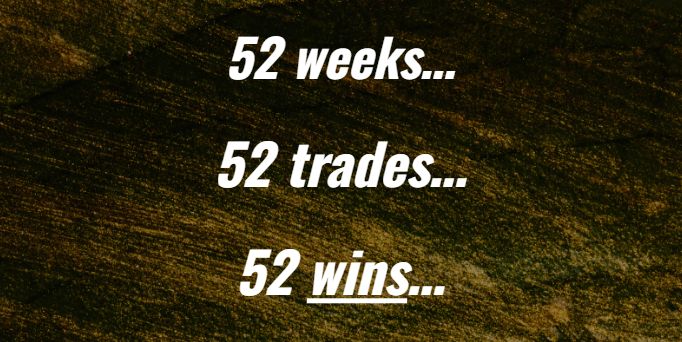
This approach produced a flawless run last year with 52 wins.
I went on camera to walk through how this approach works,
And how to take advantage of what could be the most stunning gold discovery ever.
There are no guarantees in trading, and there never will be.
But if you want to see the full breakdown of this gold glitch…
And why I believe more setups are lining up ahead,
This Is the Only Place You’ll Get the Details
Disclaimer: We develop strategies to the best of our ability, but we cannot guarantee a future return. There is always a risk of loss when trading. Past performance is not indicative of future results. Since 12/05/2024, the trading approach discussed today has published 68 signals. 65 have returned as winning trades, for a 95.6% win rate. The average return per trade, winners and losers combined, has been 12.65% on an average holding period of 10 days.