🚨 I’ll be live at with Alex at 2:30 p.m. ET🚨
[tap to join us for Profit Panel]
Let me tell you something I’ve learned after watching IPOs since the 1980s.
Lock-up periods exist for one simple reason — to prevent pump-and-dump scenarios.
Early shareholders might get shares at $10, the stock IPOs at $200, and without a lock-up, they could dump everything immediately, crushing the price right back toward where they started. That’s exactly what the lock-up is designed to stop.
You’ve seen what happens when there isn’t enough stability early on. Remember when Meta Platforms (META), back when it was Facebook, came out around the low $30s, shot up into the mid-$40s, then collapsed into the mid-teens and sat there for months?
The problem wasn’t the hype — it was that it hadn’t made money yet and the stock had no footing once the excitement faded. Hot companies can fall just as fast as they rise, and the lock-up is the buffer meant to prevent that kind of freefall.
Lock-up periods vary — anywhere from 30 days to six months — but the goal is always the same: Keep early insiders from flooding the market and destabilizing the price before the company has a chance to establish itself.
Even then, most retail traders never touch IPO shares. Brokers often require large account balances, sometimes $100,000 or more, and even that doesn’t guarantee an allocation.
Companies can shift IPO dates at any time, so building a plan around “getting in on day one” usually ends in frustration.
I don’t chase IPO shares myself. I’d rather wait for the lock-up to end and trade the reaction than gamble on whether I even get filled.
SpaceX Is Different From Most IPOs
Now, SpaceX is a different animal entirely.
Unlike a lot of tech names that go public on hope and projections, SpaceX has real revenue and real contracts. They’ve got steady business coming from NASA and other customers, and their reusable rockets have launched and landed dozens of times.
When you can fly the same vehicle repeatedly — 30 times or more — that creates the kind of recurring income and cost efficiency most companies only dream about.
That said, part of SpaceX’s valuation won’t be based on what it’s doing today but on what it’s pushing to accomplish over the next several decades. It wants to build colonies on the moon and Mars — projects no one has ever attempted at that scale.
How do you price something like that? It pushes the stock into “story mode,” where the market can swing between extraordinary optimism and cold reality.
Even with a strong business underneath, the volatility risk is enormous.
How I’d Play the First Earnings Report
The first three months of any IPO are always the diciest. Companies have never released public earnings or the kind of detailed disclosures the market demands.
Everything leading up to that moment is based on projections and promises.
When that first earnings report hits, the market finally gets a real look under the hood. The company said it would perform at a certain level — did it deliver? If yes, the stock can rip. If not, it can unravel faster than people expect.
That’s why I like hedging that moment. Buying puts is one way to protect yourself without betting against the company. Or you can run a straddle — buying a call and a put at the same strike — so you profit from a big move in either direction.
Just understand that options on a name like this won’t be cheap. High-profile IPOs come with high implied volatility, and unless the stock makes a dramatic move, the cost of the trade can eat into your gains.
For me, the plan is simple. I’m not chasing IPO shares. I’m not fighting with allocation requirements or guessing the opening price.
I’ll wait until the lock-up period expires, watch how insider selling hits the market, and then position accordingly. Patience beats hype every time.
SpaceX has real business strength, real contracts, and a proven model — but that doesn’t eliminate the chaos of those first 90 days.
Respect the volatility, have a plan, and trade the reaction, not the excitement.
Geof Smith
Geof Smith Trading
Follow along and join the conversation for real-time analysis, trade ideas, market insights and more!
- Telegram: https://t.me/+lm8_Nq3Su104NmFh
- YouTube: https://www.youtube.com/@FinancialWars
Important Note: No one from the ProsperityPub team or Geof Smith Trading will ever contact you directly on Telegram.
*This is for informational and educational purposes only. There is inherent risk in trading, so trade at your own risk.
P.S. What the Media Outlets Are Completely Ignoring Right Now
By now, you might be aware that the Senate recently confirmed the new Fed Chair.
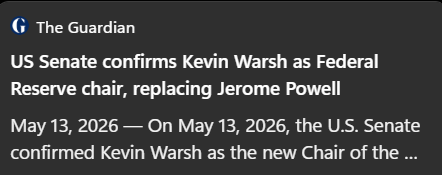
And based on my research… Warsh might set in a huge shift that I’m not seeing the media outlets talk about enough.
A shift that could prove rewarding for traders in the know.
I’ve spent three decades trading the markets…
And over the years, the Fed has singlehandedly triggered this shift, and it’s been rewarding for folks in the know.
I recently went on camera to spill the beans about this massive shift that Warsh could bring as Fed Chair.
And I also reveal the no.1 play every trader needs to know to take advantage of.
I won’t make reckless guarantees…
But if you want the details on this approach…
Tap Here to Get the Entire Breakdown
Disclaimer: We develop tools and strategies to the best of our ability, but we can’t guarantee the future. There is always a risk of loss when trading. Past performance is not indicative of future results. Since LIVE trading began on 9/18/25, there have been 24 trades, with 20 winners and 4 still open, continuing the undefeated streak. In LIVE trading, the average return has been 32.03%, and the average hold time has been 17 days.