🚨 I’ll be live at 2:30 p.m. ET with Alex Reid🚨
We’ll cover surging energy and ‘Rocket Man’ defense plays alongside the historical playbook for how markets survive and thrive during conflict with Iran [tap to join us for Profit Panel]
You’d think if you nail the move — call it perfectly — you’d make good money, right? Not always, especially not with vertical spreads.
I want to walk you through something that surprised me when I was learning options, and it still catches newer traders off guard. It’s about how time decay works differently in spreads versus outright calls.
Let me use Apple (AAPL) as an example because the math tells the whole story.
Say AAPL is sitting at $266.25 and you’re looking at the $267.50 call trading around $2.46 a contract.
That entire premium is extrinsic value — pure time value — because the strike is out of the money.
With five days to expiration, you’re losing roughly 50 to 60 cents per day in time decay on that call, and the only thing that offsets that bleed is intrinsic value from the stock climbing above your strike.
Now here’s where it gets interesting…
When Fast Moves Don’t Pay in Spreads
Say you bought a $265-$270 call spread for around $2.70 with 12 days left. Then AAPL rallies hard — maybe they drop some new must-have watch and the stock rips to $275 on Monday.
You look at your spread, see the stock well above both strikes, and think you crushed it, but you’d probably only be up about 50 cents — maybe.
That’s the part that feels counterintuitive. With a move like that, an outright call would be singing, but on a spread, the short call jumps almost lockstep with the long one because both are now well in the money.
Since the move happened fast, you get almost no help from time decay on the short call — which is what you actually need — and without that decay, the spread just doesn’t expand the way you’d expect.
The delta picture explains it. The $265 call might have a delta around 0.57 while the $270 sits near $0.41, so subtract one from the other and your net delta is about $0.17.
Even with a huge move, the spread doesn’t respond with the same horsepower as a single call would.
What You Actually Want From a Spread
With spreads, you want the stock to grind higher over time — not leap all at once — because you need the stock above both strikes while the short call slowly melts in value.
That’s how you capture the full distance between the strikes.
If the stock does spike to $275 quickly, it’s not the end of the world — you just need to let it sit there and let time do its thing. Over the next few days, the spread will widen as the short call loses its remaining extrinsic value so long as the stock stays above your two strikes.
Before putting on any spread, ask yourself whether the stock can reasonably reach your upper strike in the time you have. If you’re buying a spread at $2.70 with a $5 maximum value, the trade only works if the stock moves into the zone and stays there long enough for decay to work in your favor.
Tools like the implied move indicator on Thinkorswim help you gauge whether your chosen strikes make sense. If the projected move doesn’t support your target, pick a different structure or skip the trade.
A fast move pays better with a long call than a call spread — that’s just the math — but spreads have their place when you’ve got time and a realistic path.
👉 Click here to join Profit Panel at 2:30 p.m. ET on weekdays!
Geof Smith
Geof Smith Trading
Follow along and join the conversation for real-time analysis, trade ideas, market insights and more!
- Telegram: https://t.me/+lm8_Nq3Su104NmFh
- YouTube: https://www.youtube.com/@FinancialWars
Important Note: No one from the ProsperityPub team or Geof Smith Trading will ever contact you directly on Telegram.
*This is for informational and educational purposes only. There is inherent risk in trading, so trade at your own risk.
P.S. 3-Decade-Long Trading Veteran Makes Stunning Revelation
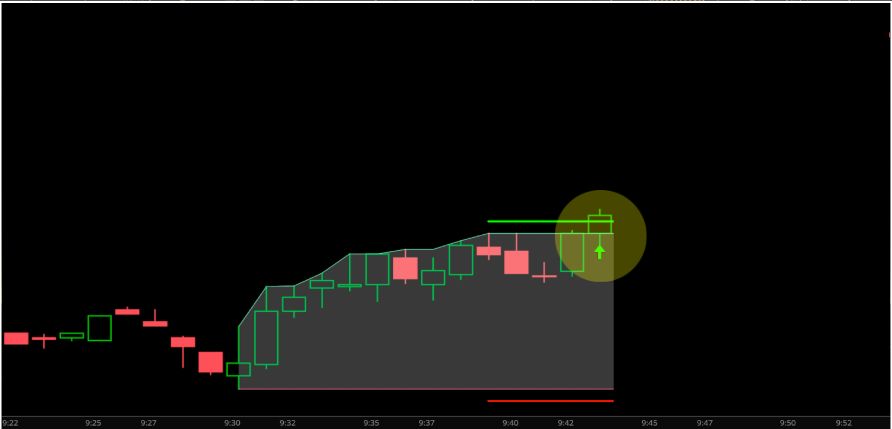
This 9:40 a.m. day trading secret has paid out up to $500 in 20 minutes or less on a $2,500 stake.
All by tapping one algo anomaly.
Wanna see the ropes?
Grab Your Popcorn — You’ll Love This
Disclaimer: The profits and performance shown are not typical; we make no future earnings claims, and you may lose money. From 11//11/24 through 2/23/25, the average win rate on live published trade alerts is 70%. The average weighted rate of return on options trades was 8.53% over a 1-day hold time.